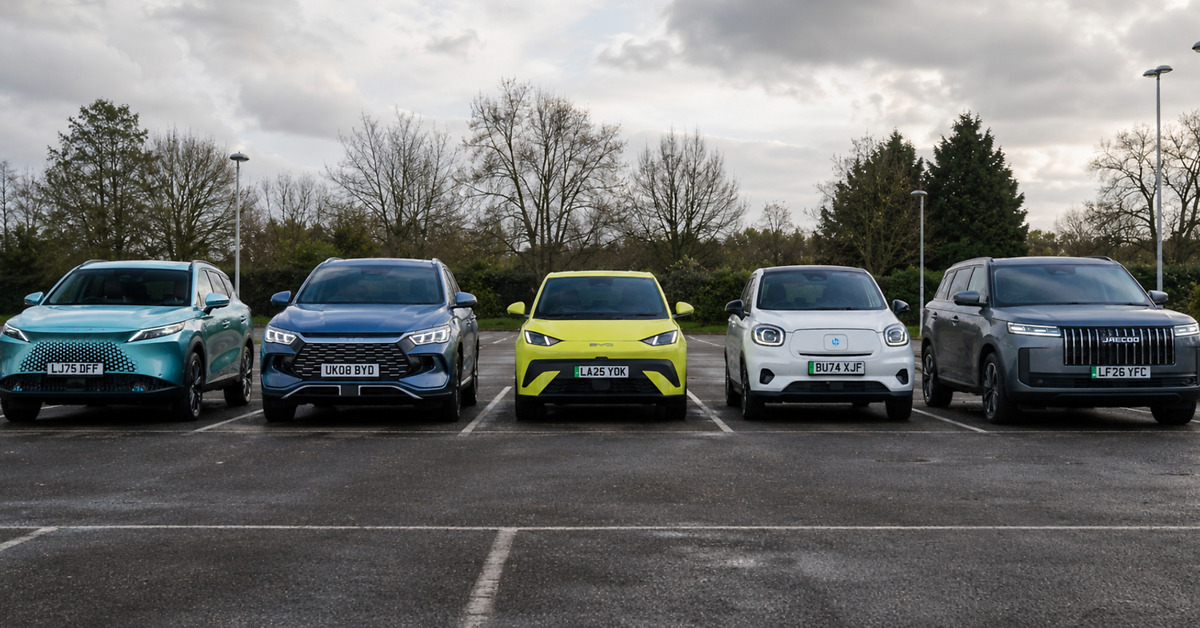
UK buyers are increasingly choosing well-specified, well-priced cars from Chinese brands that were barely known here a few years ago.
Many of these cars offer strong value, long warranties and high levels of equipment. Some are already selling in serious numbers. But are they a safe bet?
As with European, Japanese, American and Korean brands, it’s too simplistic to say that you should trust one brand and avoid another. But it does mean you should do a bit more homework before committing.
As we’ve said before, there are a lot of new names fighting for a finite number of UK car buyers, and their progress is far from even. Some of these new brands will succeed, some will struggle and some may not be around for long.
The Jaecoo 7 topped the UK new car sales chart in March 2026 and is the third-best-selling car of the year to date, with nearly 22,000 cars on the road. At the other end of the scale, Skywell has registered just 26 of its BE11 cars in the UK in the first five months of 2026.
GWM has already withdrawn the Ora 03 hatchback after poor sales since its 2022 launch, when it arrived as the Ora Funky Cat. The company now sells the Haval Jolion Pro SUV and Poer300 pick-up in the UK, although both remain unfamiliar names to most buyers.
So far, none of the new Chinese brands has left the UK. But car brands do come and go. Mitsubishi, despite being a well-known Japanese name, stopped selling new cars in Britain in 2020 to focus on other regions, before deciding to return this year. General Motors pulled its famous Chevrolet name out of Europe and sold off its Vauxhall and Opel brands to what is now Stellantis to raise money for its flagging American operations.
The lesson is not that Chinese brands are especially risky. It’s that buyers should check the practical details before being tempted by a low monthly payment or a long equipment list.
If you want to know more about a new Chinese car brand – or any car brand – your best starting point is our Car Brands Explained page.
Chinese brands featured on our Expert Rating Index
Look for a dealer first
Before buying from any unfamiliar brand – and not just a Chinese one – start by looking at the dealer network.
For newer brands, physical dealerships are particularly important. They need buyers to see the cars properly, sit in them, understand the equipment and talk to real salespeople who can answer questions. That is especially true when a brand is selling on high specification, long warranties and reassuring value.
Every manufacturer website will have a prominent dealer locator. Use it before you get too interested in the car. If your nearest dealer or service centre is too far away for routine servicing or repairs, you may decide another brand is a more sensible choice.
Many of the new brands are making big promises on coverage. Lepas, the latest brand from Chery Group to launch in the UK, has said that the majority of the population will be no more than 30 minutes from a Lepas retail and servicing outlet. Around 70 dealers are expected by the end of 2026, with dozens more planned in 2027.
BYD, which has been in the UK since 2023, already has about 130 dealerships and is continuing to add more. Omoda/Jaecoo and MG have similar numbers, which puts these Chinese brands on a par with most big European brands for dealer numbers.
Leapmotor has a different arrangement that some buyers may find reassuring. Because Leapmotor International is 51% owned by Stellantis, its cars are sold through the Stellantis dealer network. That means you may find Leapmotor models at long-established Vauxhall, Peugeot, Fiat and Citroën dealerships.
Aion, which launched in the UK this spring, is taking a more modest approach. In June, it opened eight dealerships, with four more to follow. The furthest north is in Newcastle and the furthest south is in Devon.
For customers outside those areas, Aion says buyers can discuss finance quotes and place orders through a concierge customer contact centre. Routine servicing, maintenance and repair coverage is available nationwide through an agreement with the AA, using accredited workshops and mobile technicians.
That may work well for some buyers, but it is still worth thinking about how convenient it will be if something goes wrong.
Read the warranty properly
Long warranties are one of the main ways newer brands try to reassure buyers.
Many Chinese brands offer seven-year warranties, although the cover may not apply equally to every part of the car. Battery warranties are often longer, typically around eight years.
Aion offers eight years of warranty, servicing, MOT cover and roadside assistance. MG, which is Chinese-owned but has been selling in the UK for much longer than most of the newer arrivals, also offers a seven-year warranty. Leapmotor’s cover is four years, which is still longer than the three years offered by some more familiar brands.
These warranties are clearly aimed at reducing buyer concern, and the pressure has also encouraged some established manufacturers to improve their own cover – although these usually come with the considerable caveat that you must have the car serviced by an official dealership rather than an independent garage.
Honda now offers up to five years of extra warranty on cars registered from 1 June 2026, while Toyota and Lexus offer up to seven years, as long as all work is done by official dealers using official parts. These are not the same as standard new car warranties, which is why we don’t give them any extra credit in the warranty ratings of our unique Expert Rating Index.
The important point is to read the small print. A long warranty is useful, but only if you understand what is covered, what is excluded and what servicing conditions apply.
Check parts and repair support
It is reasonable to worry that an unfamiliar car could be stuck waiting for parts if something goes wrong. The new brands know this, and many are keen to show that they are putting UK or European parts supply in place rather than relying on everything coming from China at short notice.
In the UK, DHL handles parts warehousing and distribution for Chery Group brands Omoda, Jaecoo, Chery and Lepas from Rugby. The company says the most common parts will arrive at service centres within 48 hours of order, seven days a week.
Aion is setting up a parts warehouse in Bury St Edmunds, while Leapmotor can use Stellantis parts logistics.
That is reassuring, but it does not remove the need to check. If you are buying a car from a very new brand, ask the dealer how servicing, accident repairs and parts supply will work. It is much better to ask before ordering than after a problem appears.
Get an insurance quote before ordering
Insurance is one of the most important checks for any new Chinese-brand car. Some models are so new, or so rare on UK roads, that insurers have limited repair data. They may not yet know how costly a car is to fix after a crash, how easy parts are to source or how quickly repairs can be completed.
That does not mean you will be unable to insure the car. In most cases, customers are getting cover. But if fewer insurers are willing to quote, there is less competition, and that can mean higher prices.
Earlier this year, car buying and leasing site Carwow, one of our partners here at The Car Expert, gathered sample insurance quotes for eight models: four from Chinese brands and four from established European, Korean and Japanese manufacturers.
Out of ten insurers contacted, nine were unable to provide a quote for the Skywell BE11. For the Jaecoo 7, half the insurers declined to quote and the average price from those that did was £166 higher than for a comparable European model.
The picture is not the same for every brand. Carwow found better results for the BYD Seal U, sometimes cheaper than Japanese or Korean alternatives.
BYD has also entered a 12-month agreement with insurance research body Thatcham Research, aimed at improving understanding of damageability and repair standards for its UK model range. That is a positive longer-term step, although it does not necessarily make insurance cheaper today.
Some new brands also offer their own insurance products, which may help. But whatever the brand offers, always get insurance quotes before you commit to buying the car.
Think about future value
Most new cars are not bought outright. They are usually funded by monthly payments, often through a PCP agreement.
A PCP, or personal contract purchase, gives the car a guaranteed future value at the end of the agreement. You can pay that amount to own the car, hand it back or start another deal.
This is relevant because the motor trade is still working out how these newer Chinese-brand cars will perform as used cars. Some may hold their value well. Others may not.
Speaking to The Car Expert, Derren Martin, consultant automotive values advisor to used car data provider Cazana, says the value proposition is currently strong for new car buyers.
“I think it’s great news for the consumer because the offers are so competitive,” he says.
“But obviously that monthly payment is built on a strong residual value so if no one’s buying the used ones that new car monthly payment becomes unsustainable.
“The consumer should only be worried about residual values if they’re not buying on a monthly payment. If they’re planning to buy it outright and then sell it in a few years’ time, then they should be concerned.”
His point is that residual values may not be a major concern for buyers leasing or using PCP, because the risk is partly built into the finance product. But anyone buying outright and planning to sell in a few years should think more carefully about future value.
What happens when they become used cars?
Fleet buyers are now taking Chinese-brand cars in much larger numbers, so many of these vehicles will start arriving on the used market in the next few years. BYD will be among the first in serious numbers, as it launched in the UK in 2023.
That will create a new challenge. If manufacturers keep offering very competitive new car deals, used versions need to look attractive as well.
Martin says this is an issue the new brands will need to manage carefully.
“The biggest issue for me is how good the new car offers are. Why would you buy a used one? Everyone gets a new one because the monthly payments are very, very similar. You can get 0% finance on a new one. It’s about 9% on a used car.
“These brands have to set up a good used car programme. They must do that to maintain value and make those used cars attractive; otherwise, the new car offer doesn’t work going into the future.”
There is some good news for used buyers. Long warranties are usually transferable from one owner to the next, provided the car has been serviced correctly. That means a three-year-old car from one of these brands may still have several years of manufacturer warranty remaining.
What about reliability?
It is still too early to say how reliable most of these newer Chinese-brand cars will be over the long term in the UK.
That does not mean they should be assumed to be unreliable. Many of the companies are new to British buyers, but not new companies. They are large, established manufacturers in China and, in many cases, sell cars in several other markets.
MG is the only Chinese-owned brand with enough UK history to give much long-term reliability data, but even that needs careful handling.
Our expert partner MotorEasy publishes a Reliability Index based on real warranty claims data. MG currently ranks 33rd out of 47 brands, with an overall score of 4.3 out of ten. That might not sound impressive, but it puts MG just ahead of Mazda and well ahead of Audi.
However, MG’s model range today is significantly stronger than the cars it was selling less than a decade ago. The brand has improved quickly, so older perceptions of MG should not necessarily be applied to newer models.
That makes a wider point about Chinese cars generally. Opinions can become outdated quickly. A car or brand that seemed cheap and rough ten years ago may be very different today.
Martin does not expect major reliability problems. “Obviously, the longer they’re around the more we’ll find out, but most of these companies are very well established in China and their cars are then engineered for the UK roads.
“They’ve got history, they’re not completely new – they’re just new to the UK, so I wouldn’t expect there to be reliability issues going forward.”
The bottom line
Buying a car from a new Chinese brand is not something to dismiss, but it does require some careful considerations.
Many of these cars offer strong value, generous equipment and long warranties. Some are already proving popular with UK buyers, and several come from major companies with serious global ambitions.
But the badge on the bonnet is only part of the story. Before signing, check where your nearest dealer is, what the warranty really covers, how servicing and parts supply will work, what insurance will cost and how much resale risk you are taking on.
If the car still looks good after those checks, there is no reason to rule it out simply because the brand is new to the UK.
Read more: