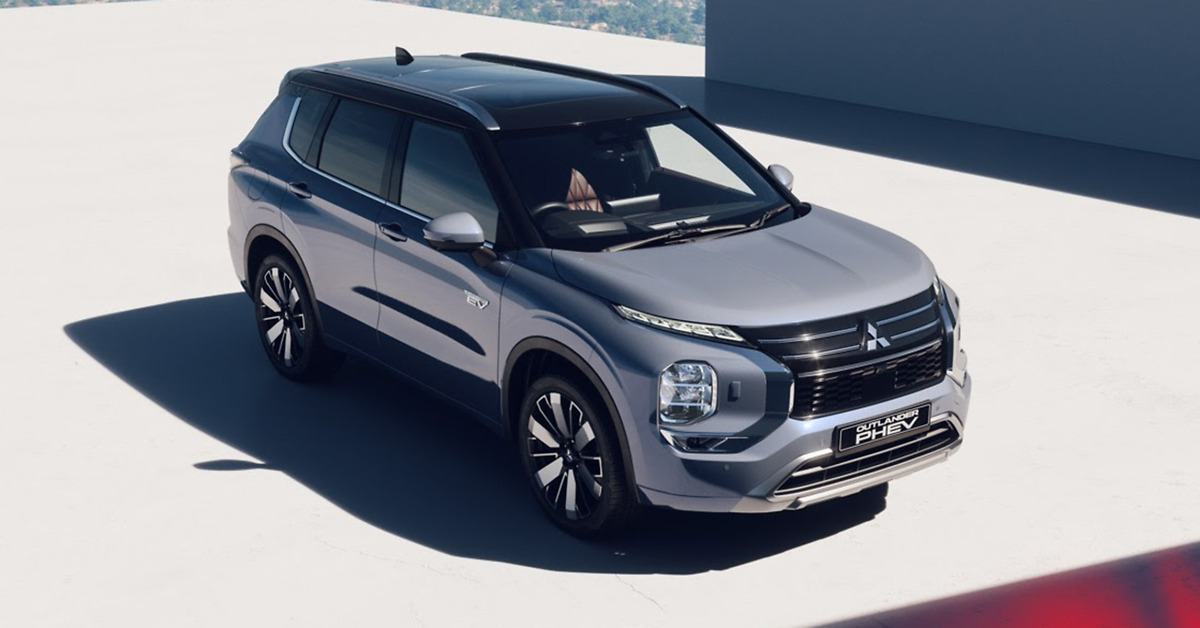
Ahead of the new Mitsubishi Outlander PHEV arriving in UK showrooms this month, the Japanese brand has revealed more details about the technology that underpins its flagship SUV.
Mitsubishi says two key features set the model apart from many rivals: its Super All-Wheel Control (S-AWC) four-wheel-drive system and its ability to automatically switch between three different driving modes to maximise efficiency and performance.
Rally-inspired four-wheel-drive tech
At the heart of the Outlander PHEV is Mitsubishi’s Super All-Wheel Control system, a technology developed from the firm’s decades of experience in the World Rally Championship and Dakar Rally.
Unlike many conventional four-wheel-drive systems that use mechanical driveshafts to connect the front and rear axles, the Outlander uses separate electric motors at each axle. This allows the car to vary power distribution almost instantly depending on grip levels and driving conditions.
The system also incorporates ‘Active Yaw Control’, which uses torque vectoring and selective braking to improve cornering stability. By automatically adjusting power delivery between the left and right wheels, the Outlander can remain more stable through bends while requiring less corrective steering input from the driver.
Seven drive modes for different conditions
Drivers can also choose from seven terrain settings depending on road and weather conditions.
These include ‘Normal’, ‘Eco’ and ‘Power’ modes for everyday driving, alongside dedicated ‘Tarmac’, ‘Snow’, ‘Gravel’ and ‘Mud’ settings designed to optimise traction and stability on more challenging surfaces.
Mitsubishi says the various systems work together simultaneously, rather than switching between different traction and stability functions independently, helping the SUV maintain grip and composure with minimal driver intervention.
How the plug-in hybrid system works
The Outlander PHEV’s plug-in hybrid powertrain is designed to operate primarily as an electric vehicle, automatically switching between three driving modes depending on battery charge levels and power demands.
In ‘EV’ mode, the SUV runs solely on electricity using its front and rear electric motors. This is the default setting when the battery has sufficient charge, allowing quiet, zero-emission driving.
When additional power is required — such as during hard acceleration or hill climbing — the system can switch into ‘Series Hybrid’ mode. Here, the petrol engine acts as a generator, producing electricity to power the motors and recharge the battery, rather than directly driving the wheels.
At higher cruising speeds, or when battery charge is low, the Outlander can move into ‘Parallel Hybrid’ mode. In this setting, the petrol engine directly powers the wheels while the electric motors provide additional assistance when needed. Any surplus engine power can also be used to top up the battery.
The transitions between modes are automatic and designed to be virtually imperceptible to occupants.