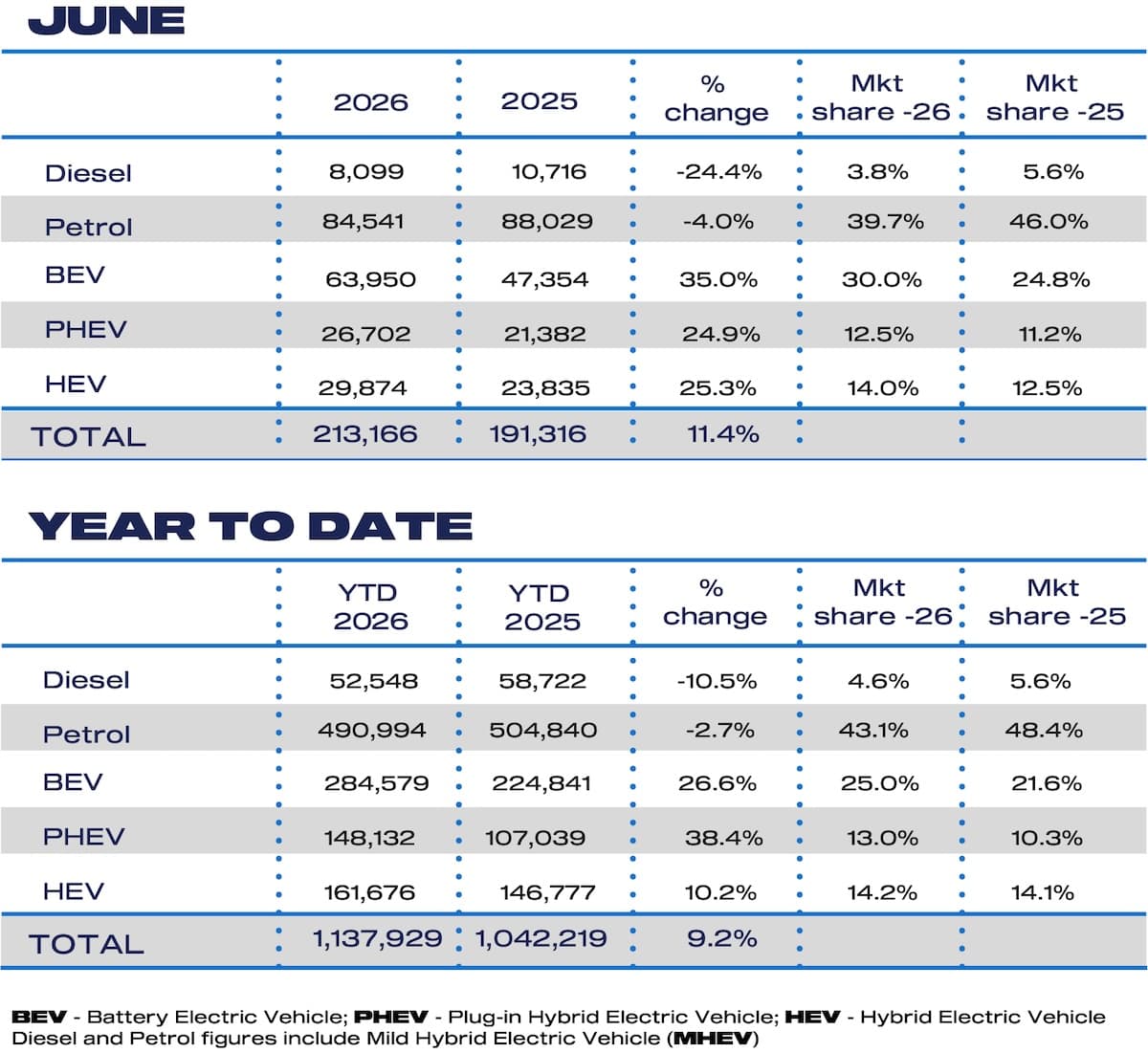
New car registrations had a strong month in June, with numbers up by 11% over the same month last year.
Both private customers and fleet buyers showed strong improvements. But, as always, what was really interesting was where that growth was coming from. Electric cars provided the largest jump in numbers – up an impressive 35% over last June – while Chinese brands continue to account for almost all the growth in sales numbers.
Record month for electrification
Although the overall new car market was up by 11% (about 22,000 cars) in June, the growth in EVs and plug-in hybrids accounted for about 21,900 of those 22,000 extra cars.
“Electrified” cars – EVs, plug-in hybrids and basic hybrids – took more than 56% of all new car registrations in June, which is a new record market share. Purely petrol cars slipped just below 40%, while diesel continued its slow slide towards oblivion at less than 4%.
As the lack of any proper resolution to the crisis in the Middle East keeps petrol prices high and prolongs uncertainty, buyers continue to move towards electric cars. They took 30% of the market, with plug-in hybrids taking another 13% and regular hybrid 14%.
As we hit the halfway point of the year, EVs make up exactly 25% of new car registrations – which is pretty much on target to hit this year’s government EV mandate once all the various allowances and flexibilities have been taken into account.
Good month, bad month
Although the overall new car market was up by 11% (about 22,000 cars), the results were decidedly mixed when looking across all the manufacturers. As has been the case for the last year, Chinese brands accounted for pretty much all of the growth, with most legacy brands treading water or sinking.
It was a good month for Abarth, Alfa Romeo, Alpine, BYD, Chevrolet, Jaecoo, Jeep, Leapmotor, Lotus, Maserati, MG, Mini, Omoda, Porsche, Skywell*, Smart, Suzuki, Tesla and Xpeng. All of these brands outperformed the market by at least 10%, meaning that they grew their registration numbers by at least 21% over last June.
Meanwhile, things weren’t so good for BMW, Citroën, Cupra, Ford, Genesis, Honda, Hyundai, Ineos, KGM, Land Rover, Lexus, Mazda, Maxus, Mercedes-Benz, Nissan, Peugeot, Polestar, Subaru and Volkswagen. All of these brands underperformed against the overall market by at least 10%, meaning they either grew sales by less than 1% or lost numbers compared to last June.
That means the following brands were about where we’d expect them to be: Audi, Dacia, Fiat, Kia, Renault, SEAT, Skoda, Toyota, Vauxhall and Volvo. All of these were within +/-10% of the overall market.
Volkswagen continues its unchallenged run as the UK’s biggest new car brand, although Tesla jumped into second place with a very strong month, ahead of BMW, Audi and MG.
The biggest growth in absolute terms came from Tesla, up nearly 4,500 cars or 58% on the same month last year. Going the other way, the biggest faller was Nissan, which was down nearly 1,800 units or 19% in a market that was up 11%.
*Actually, Skywell had a very bad month rather than a good month as suggested by registration numbers. The importer registered all its remaining Skywell stock in June and closed the brand’s doors, making all the staff redundant. Skywell is apparently now looking for a new distributor to re-enter the UK market.
Tesla scores a 1-2 in June
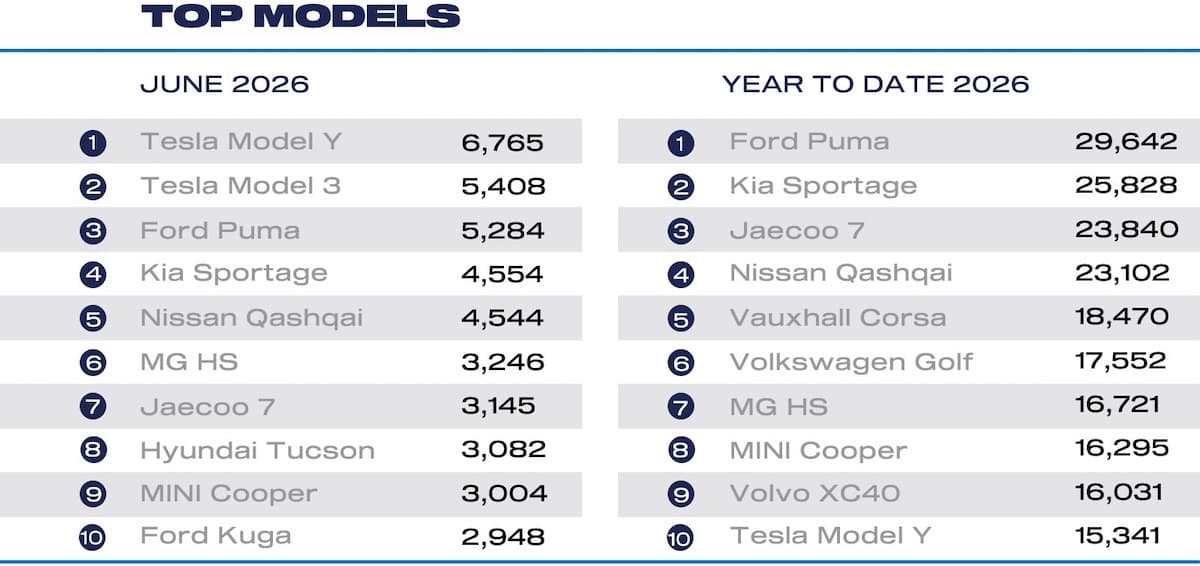
Tesla’s two models occupied the top two spots in the best-seller charts in June, with the Model Y crossover ahead of the Model 3 saloon. It’s important to remember that Tesla’s numbers fluctuate more than most brands, as it doesn’t operate a traditional retail network up and down the country, so its registrations tend to spike whenever a new boatload of cars arrives from its factories in Germany or China.
The Ford Puma placed third, extending its lead in the 2026 new car sales race as we reach the halfway point of the year. Right behind it was its erstwhile sales rival, the Kia Sportage, just ahead of the UK-built Nissan Qashqai.
Chinese brands had two cars in the top ten, with the MG HS in sixth, just ahead of the Jaecoo 7 in seventh.
Despite being the UK’s best-selling brands, Volkswagen didn’t have any models in the top ten in June.