If you’ve driven a newer electric car, you may have noticed a strange driving mode which allows you to slow down – and sometimes even come to a complete stop – without touching the brake pedal.
This is known as one-pedal driving, and it’s becoming increasingly common in electric cars and some plug-in hybrids. For some drivers, it quickly becomes second nature. For others, it feels completely unnatural. It won’t transform how a car drives, but it can make everyday driving smoother and slightly more efficient.
So what exactly is one-pedal driving, how does it work, and is it something you should actually use?
What is one-pedal driving?
One-pedal driving is a mode that allows you to control both acceleration and braking using just the accelerator pedal.
Press the pedal and the car speeds up, lift off the pedal and the car slows down – its as simple as that. In many cars, lifting off fully will bring the car to a complete stop without needing to use the brake pedal at all.
How does one-pedal driving work?
At its core, one-pedal driving relies on something called regenerative braking.
When you lift off the accelerator, the car’s electric motor runs in reverse and instead of using energy, it generates electricity that is fed back into the battery. At the same time, this process slows the car down—sometimes quite strongly.
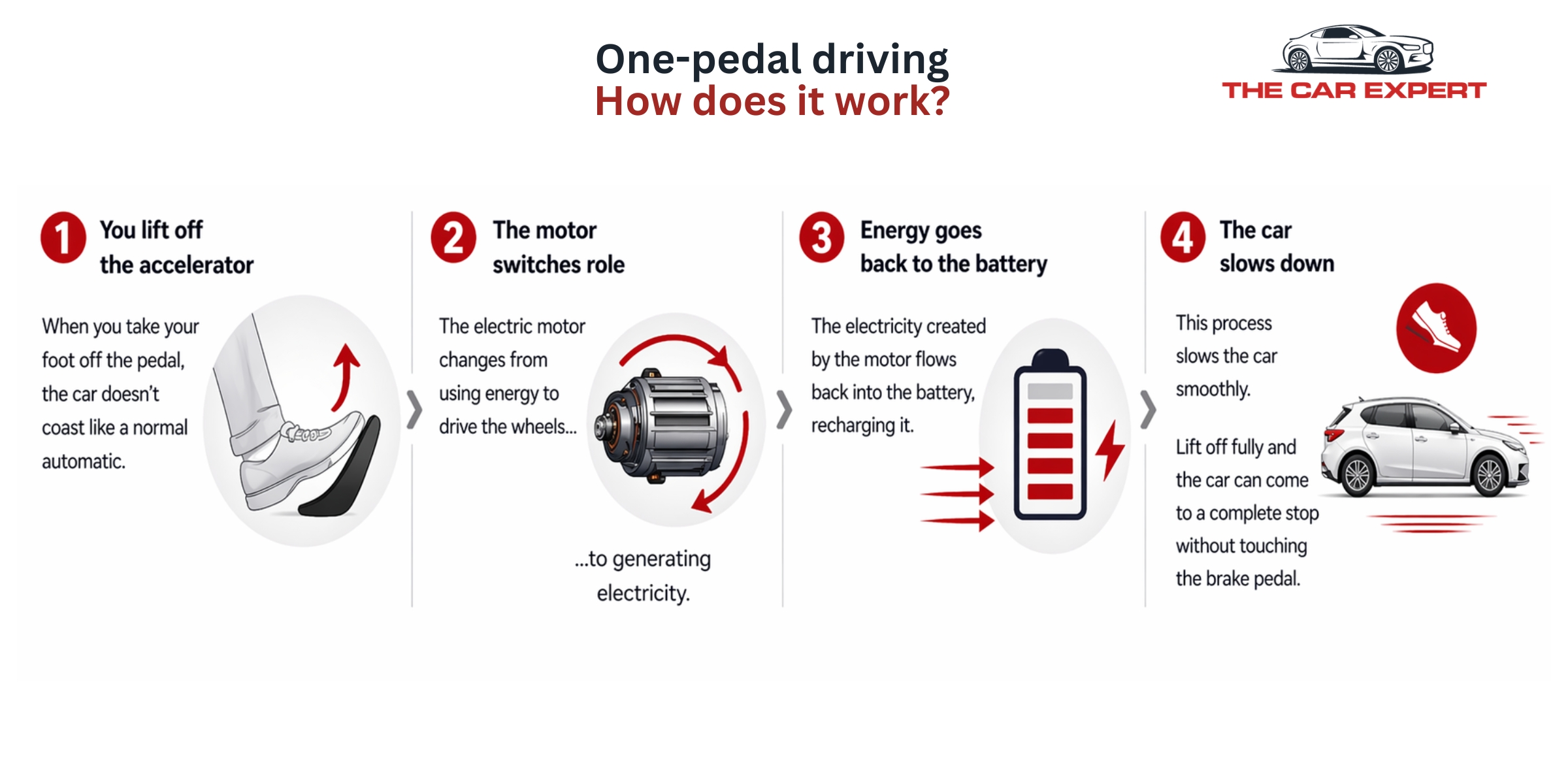
One-pedal driving is more energy efficient, as it helps recover energy that would otherwise be lost as heat through braking. However, the overall efficiency gain depends on how you drive. In steady motorway cruising, the benefit is minimal. In urban driving, it can make a noticeable difference.
What does it feel like to drive?
It can take a bit of brain training to get used to. With one-pedal driving turned on, the car slows down as soon as you lift your foot and therefore you need to be more precise with your pedal control.
At first, many drivers find themselves slowing down too quickly or too early. But after a few days, most adapt and some prefer it, particularly those drivers that spend plenty of time in bumper-to-bumper traffic.
The pros and cons
Pros
By maximising regenerative braking, the car recovers more energy, which can help improve efficiency – especially in stop-start traffic.
Less use of the brake pedal
In everyday driving, particularly in town, you may rarely need to touch the brakes.
Smoother driving in traffic
Once you get used to one-pedal driving, it can make stop-start driving feel more controlled and less tiring.
Because the physical brakes are used less often, they may last longer over time.
Cons
Takes time to get used to
It feels unnatural at first, particularly if you’re used to coasting.
Can jerk the car back and forth if not used properly
Small movements of your foot can lead to noticeable changes in speed.
Not always ideal at higher speeds
On motorways or fast roads, some drivers prefer traditional coasting for smoother progress.
Which cars offer one-pedal driving?
One-pedal driving is most commonly found in electric vehicles (EVs). Even where it’s available, it’s usually optional – you can switch it off or adjust the strength of the regenerative braking. This drive mode is widely available in new EVs, such as:
Some plug-in hybrid models with powerful electric motors have one-pedal driving, like the Volvo XC60 and BMW X5 PHEVs, but it is generally less common.
Read more: