Make and model: Jeep Compass Electric First Edition
Description: Mid-sized SUV
Price range: from £34,520
Summary: The Jeep Compass has been electrified, but is this rugged SUV as good as its rivals?
Introduction
Now in its third generation, the Jeep Compass is offered with electric power for the first time.
Measuring 4.5 metres in length, it competes with the Tesla Model Y, Skoda Enyaq, Kia EV5, and Volkswagen ID.4. Unlike those rivals, the Compass is not only available in fully electric form, but also as a petrol model with mild hybrid assistance.
We drove the all-electric First Edition model, which had a dual-pane sunroof and was fitted with the optional Convenience Pack and Premium Pack. More on those options later.
Price and equipment
A starting price of £34k gets you an entry-level Altitude trim Compass with the 1.2-litre petrol engine, which Jeep claims is good for around 50mpg. The electric variant starts from £37k, while the range-topping First Edition lands at £39k. The car I drove cost more than £45K after factoring in the additional options.
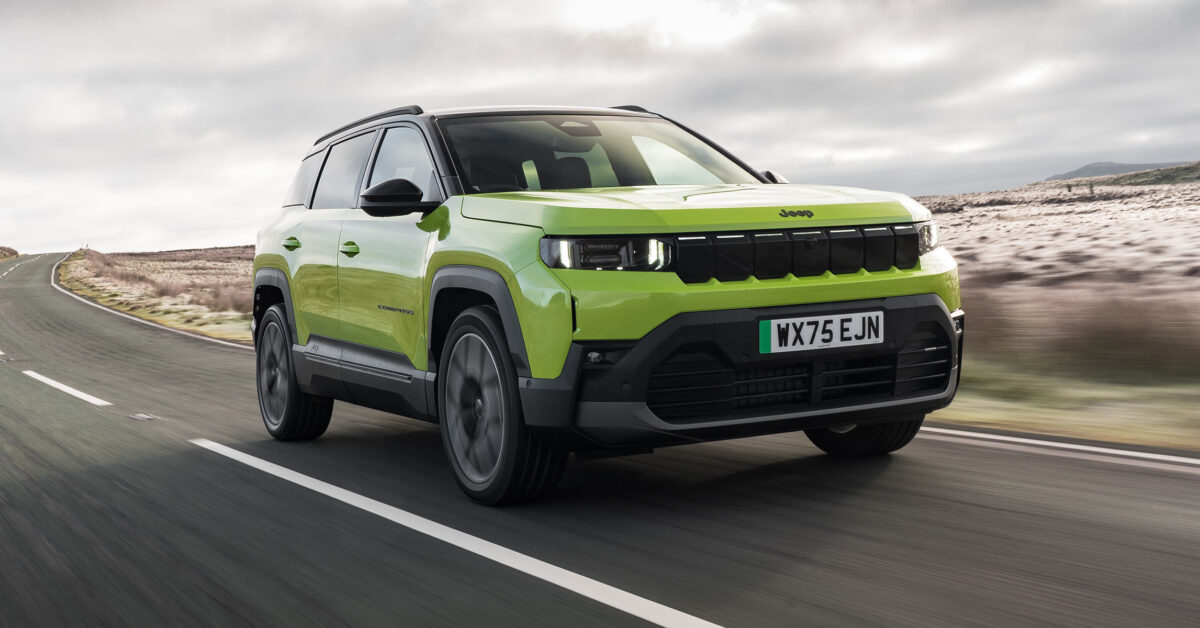
There’s only one free colour across the range: Hawaii Green, which I liked but might not be to everyone’s taste. Want another colour? That’ll be £800, please.
Still, Jeep’s thrown in quite a fair bit of tech as standard, including a ten-inch digital instrument display, a 16-inch touchscreen, sat-nav, USB-A and C charging, an electrochromic rear-view mirror, front and rear parking sensors, and Level 2 autonomous driving. Annoyingly, a heat pump to improve cold-weather driving range and battery preconditioning is an extra £850. This should really be standard on every EV in 2026.
Stepping up to the First Edition adds the heat pump, along with increasing the alloy wheel size from 19 to 20 inches, and adds keyless entry, a heated windshield, wireless phone charging and more advanced ambient lighting. If you want a heads-up display, you’ll still need to spend £1,500 for the advanced driving pack. Ventilated and massaging seats and a premium audio system are available as another pack at another £1,500.


Inside the car
The Compass’s interior is typically Jeep: rugged and tough. Ambience isn’t its strong point, but the driving position is spot on, even for tall drivers. There are also plenty of grab handles throughout the cabin if you were to come across uneven terrain – not that most owners are likely to tackle much more than the occasional dirt road.
The touchscreen system is shared across several Stellantis brands, including Peugeot, Vauxhall and Citroën, and can be a little slow at times, but it’s not overly complicated to use.
There’s a smattering of physical switches for key functions to minimise touchscreen faffing, and all cars get a terrain control system to optimise the systems for different surfaces.
The new Compass is slightly larger and longer than the last one, which has improved rear head and legroom. Opting for the panoramic roof will reduce headroom slightly, but you’ll struggle to notice unless you’re very tall.
The boot offers a good 550 litres of space, and while there’s no frunk (storage compartment under the front bonnet), it does have deep underfloor storage in the boot – ideal for stashing charging cables.


Driving range and charging
Jeep claims the Altitude will return up to 304 miles on a fully charged 74kWh battery, putting it behind the Enyaq’s 360 miles and the Kia EV5’s 329 miles. However, it beats the VW ID.4 Pure Essential’s 224 miles. Opt for the First Edition, and you’ll see a slightly lower 290-mile range.
If more is needed, you can wait until later in the year for the larger 97kWh battery, which should return around 375 miles.
All cars get standard home charging as standard, with a faster (22kW) home charging option available if required, though it’s worth noting that many homes can’t support the higher speeds. Charging the smaller battery from empty to full via a typical 7kW home wallbox will take just under 12 hours. The Compass also supports charging up to 160kW at suitable public charging stations, meaning a 10-80% charge will take around half an hour.
On the road
As with most electric cars, the Jeep Compass has more than enough power for everyday use. For now, all cars are front-wheel drive only, but a four-wheel-drive performance variant will follow at some point.
Nevertheless, the standard car felt fizzy enough on windier tarmac, although I wouldn’t go as far as calling it exciting.
Our launch event took us through the Cotswolds countryside, where the Compass Electric felt most at home at cruising speeds. Its turning circle is spot on for an SUV of this size, and there’s plenty of visibility from the lofty driving position. Bumps and harsh lumps are well damped, although there was some notable motor whine and wind noise at speed.
It also features adjustable levels of regenerative braking, which is adjusted via the steering wheel-mounted paddles, and there’s a one-pedal drive switch on the dashboard.
We never got to test its off-road ability, but most family car owners don’t take their SUVs further off the tarmac than a summer campsite anyway, so there’s not too much to worry about.


Verdict
The Jeep Compass Electric is a good-looking car – we particularly liked the bright green colour, although you probably won’t see too many customer cars ordered in that shade. It also feels good on the road, offers plenty of space inside, is competitively priced, is easy to drive, and comes with lots of standard equipment.
While it’s a massive improvement over its predecessor, however, the Compass still falls short of some other family electric SUVs that are vying for your money. The cabin is less appealing than several alternatives, while the noise at motorway speeds was also more than we’d like. It’s still quieter than a petrol or diesel SUV, but not as hushed as you feel in other similar cars.
If you like the look and overall features of the Jeep Compass Electric, it will serve you well. But with more than 30 brands offering electric SUVs of a similar size and/or price range, we’d still suggest you look at what else is on offer before committing.
We like:
- Rugged, distinctive design stands out from the crowd of increasingly similar electric SUVs
- Driving offers good visibility and comfortable seating, even for taller drivers
- Easy to drive
- Good head and legroom
We don’t like:
- Motor whine and wind noise at motorway speeds
- Cabin materials feel a step behind the best in class – functional rather than premium
- Optional extras quickly drive the price up
- Not as refined overall as the best alternatives at a similar price
Similar cars
Alpine A390 | Audi Q6 e-tron | BMW iX3 | BYD Sealion 7 | Changan Deepal S07 | Citroën ë-C5 Aircross | Cupra Tavascan | DS Nº7 | Ford Mustang Mach-E | Geely EX5 | Genesis Electrified GV70 | Hyundai Ioniq 5 | KGM Torres EVX | Kia EV5 | Leapmotor C10 | Lexus RZ | Mazda CX-6e | Mercedes-Benz GLC EQ | MG S6 EV | Mini Countryman Electric | Nissan Ariya | Peugeot E-3008 | Renault Scenic E-Tech | Skoda Enyaq | Skywell BE11 | Smart #5 | Subaru Solterra | Tesla Model Y | Toyota bZ4X | Vauxhall Grandland Electric | Volkswagen ID.4 | Volvo EX60 | Xpeng G6
Key specifications
Models tested: Jeep Compass Electric First Edition
Price as tested: £45,300
Powertrain: 74kWh battery and single motor
Gearbox: Single-speed automatic
Power: 210 hp
Torque: 345 Nm
Top speed: 115 mph
0-62mph: 8.5 seconds
Battery range: 310 miles
CO2 emissions: 0 g/km
Euro NCAP safety rating: Not yet tested (April 2026)
TCE Expert rating: Not yet rated (April 2026)