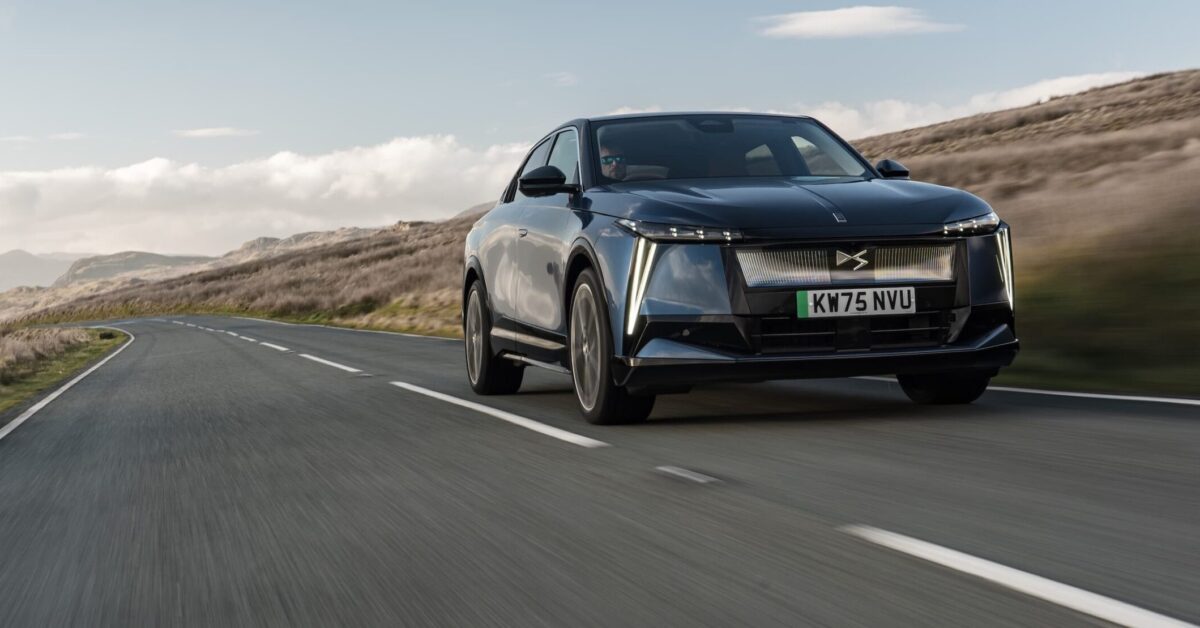
Make and model: DS Nº8 Étoile AWD
Description: Mid-large electric coupé-SUV
Price: £63,290 (£69,000 as tested)
Summary: The DS Nº8 is not a bad car, but it’s simply not good enough to compete at more than £60K.
Introduction
DS does things differently. It’s a French car brand that decided its cars should look and feel unlike anyone else’s, rather than follow the established German template for what a luxury car should be. The DS Nº8 is its most expensive and most ambitious model – a large electric SUV that costs as much as a BMW or Mercedes, and needs to justify it.
In a consumer market that tends be obsessed with German precision or Tesla-style minimalism, DS leans into something altogether more French – theatrical, textured, unapologetically distinctive. With a growing number of new car brands that seem to be little more than Tesla copycats, there’s an admirable quality about a brand that wants to define premium on its own terms.
The DS Nº8 is an electric-only model, designed to whisk four adults (five at a squeeze) along in comfort – even over long distances at motorway speeds, which is not normally a strength for electric cars. That is the sort of territory that cars like the BMW 5 Series and Mercedes-Benz E-Class have traditionally dominated, and customers of those vehicles haven’t really embraced EVs with as much gusto as buyers of urban-focused small SUVs.
I wanted this review to go well. There’s something appealing about a car brand with the confidence to do things its own way, and the Nº8 looked promising on paper. But after a day behind the wheel, I came away disappointed in the drive – at least in the specification of our press car, which I’ll come to shortly.
For a broader ownership picture, see our full DS Nº8 Expert Rating.
Price and equipment
The Nº8 comes in two trim levels: Pallas (from just under £51K) and Étoile. The car I drove was the Étoile all-wheel drive Long Range, with 350hp and a base price of just over £63K. Add a panoramic roof, upgraded leather interior and a set of optional 21-inch alloy wheels, and the total came to just under £69K.
Almost touching £70K is a big ask for any French car brand, especially one whose previous flagship models (DS 7, DS 9) have sold in underwhelming numbers.
At that price, you’re looking at the same alternatives as someone considering a BMW iX3 or a Volvo EX60. DS argues that the Nº8 will hold its value better than most rivals when you come to sell it, which would help bring down the overall cost of ownership. But large, expensive French cars have not historically been strong on resale values, and I’d want to see actual evidence before factoring that into a buying decision.
Both trim levels are well specified. Even the entry-level Pallas comes with a solid level of equipment. The Étoile adds a distinctive full-width light bar at the front, better interior materials and a suspension system that uses a camera to try to improve the ride – more on that later.


Inside the car
The cabin is where the Nº8 makes the strongest case for itself. The materials feel genuinely expensive: there’s a distinctive stitched pattern on the seats, brushed metal detailing on the door speakers and centre console, and the overall impression is of a car that’s been designed with care rather than just assembled. The main touchscreen is large and quick to respond, the head-up display puts key information in your eyeline as you drive, and the front seats are heated and ventilated.
There are also small fans built into the top of the front headrests that blow warm air towards the back of your neck. It’s an unusual idea that works in principle. On our car, one of the fans buzzed audibly throughout the drive – probably a fault with the specific car, but not what you’d expect on a car at this price.
The steering wheel is polarising. Its four X-shaped spokes are visually dramatic but the rim itself isn’t as comfortable to hold as the best in this class – Volvo, for comparison, sets a high standard for steering wheel comfort that the DS doesn’t match.
The more significant problem is rear passenger space. I’m 180cm tall – just under six foot – and sitting in the back, my head was touching the roof. Anyone taller will be uncomfortable. For a car that’s supposed to be a luxury product, that’s a meaningful shortcoming.
The boot holds around 620 litres, and is long and fairly shallow, which means it suits bags laid flat better than suitcases standing upright. It’s more practical than many saloons but less versatile than a conventional SUV or estate.


Driving range and charging
The version I drove is claimed to cover 427 miles on a full charge, based on the standard laboratory test. Real-world range will be lower, but it’s a competitive number. If you’re weighing up the all-wheel drive version against the cheaper front-wheel drive model, it’s worth knowing the front-wheel drive version claims up to 466 miles – a meaningful difference if you don’t specifically need all-wheel drive. Either way, more than 400 miles is much more than most households will really need.
DS says the car can charge from 20-80% in just under half an hour at a public charging point. Charging peaks at 160kW, which is lower than some rivals. DS’s response is that its system is engineered to maintain a higher average charging speed throughout the session rather than peaking quickly and then dropping off. That’s a reasonable argument, but one we weren’t able to verify on the day as we didn’t charge the car.
Home charging runs at 11kW. The car can also supply power to external devices – useful for camping, or running tools on a building site. An option that allows two-way charging, so you can use the car to run your home or sell power back to the grid, is available at extra cost.
On the road
The Nº8 uses a camera-based adaptive suspension system that watches the road ahead and adjusts the suspension before each bump arrives, rather than waiting until the wheel hits it. In Comfort mode, it works reasonably well – the ride is composed, if not quite as smooth as the best cars in this class. It works best on motorway-style roads rather than mixed surfaces, as the handling wallows around in a manner that’s not particularly pleasant when the road gets twistier.
In Sport mode, the adaptive system switches off entirely, leaving the suspension in a firmer fixed setting that was noticeably uncomfortable yet still doesn’t provide a confidence-inspiring driving experience. Flicking through Comfort, Normal and Sport failed to find a happy balance on our test route.
Our car was fitted with optional 21-inch wheels, which looked great but may have been detrimental to the driving experience. But the bigger problem with these wheels was the noise they produced. Concrete surfaces on the M25 motorway produced an almost deafening roar, and our phone-based sound level meter consistently recorded noise levels above 100dB while driving at 70mph – not what you’d expect at this price point and directly at odds with the car’s comfort-oriented persona. Levels on other road surfaces were not much better, with far too much road noise for what was an almost £70K luxury-oriented car.
Other reviewers who drove the Nº8 on the standard 20-inch wheels didn’t report the same issue, so this may be specific to the bigger wheels. The driving score below reflects the car as we tested it, and we’ll re-evaluate this if we drive the car again on the standard wheels.
In other driving aspects, the Nº8 works well. There’s strong, smooth acceleration, the car feels stable at motorway speeds, and the cruise control system adjusts your speed automatically as you approach bends by reading the navigation map. That last feature is genuinely useful on a longer journey.


Verdict
The DS Nº8 is a car I would love to recommend. The interior is genuinely impressive, and there’s something refreshing about a car that doesn’t look or feel like everything else at this price.
But the problems are real and they’re not minor, like rear headroom that rules out taller passengers, tyre noise on the larger wheel option that requires passengers to shout at one another to be heard, and suspension tuning that fails to find a happy compromise between comfort and handling. At nearly £69,000 as tested, these aren’t things you should have to accept. DS has the right idea, but the Nº8 just isn’t quite the finished article.
For a broader ownership picture, see our full DS Nº8 Expert Rating.
We like:
- Interior design and material quality are genuinely premium and carefully considered
- Camera-based adaptive suspension works well in Comfort mode
- Range of 400+ miles in all versions is more than enough for almost all buyers
- Cruise control that adjusts speed ahead of bends is genuinely useful technology
- Generous standard equipment levels
We don’t like:
- Tyre noise on (optional) 21-inch wheels is seriously poor for a car at this price
- Rear headroom is inadequate for taller passengers
- Sport mode is uncomfortable and not really sporty
- Neck warmer fan produced an audible buzzing noise throughout our drive
- Pricing puts it in direct competition with better cars