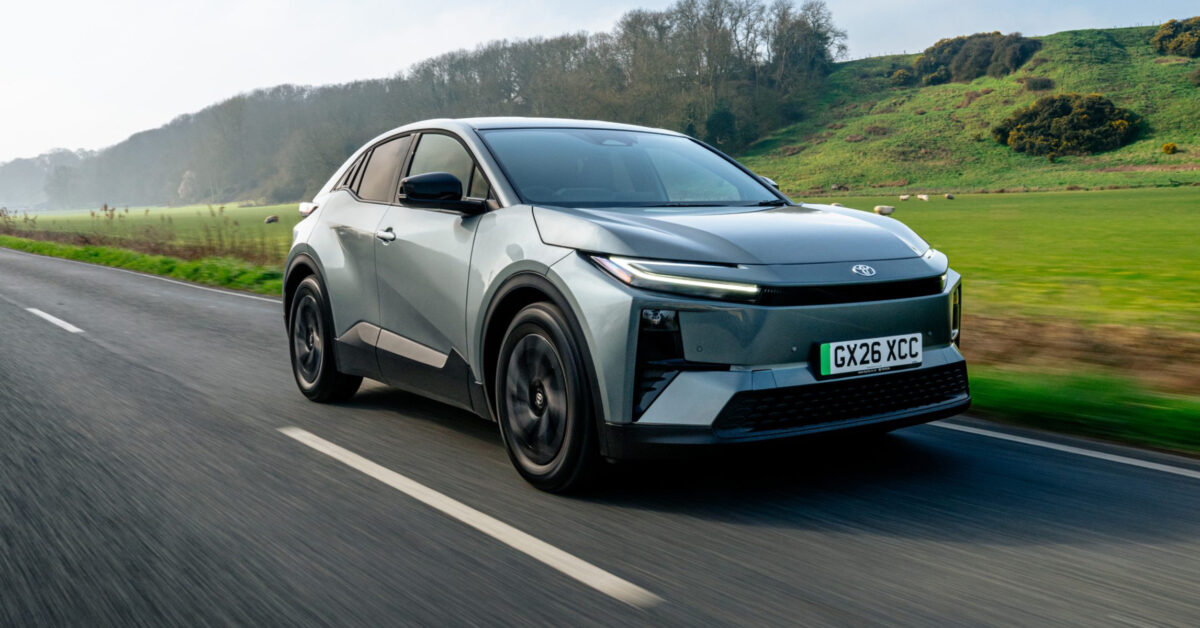
Make and model: Toyota C-HR+
Description: Mid-sized electric SUV
Price range: £34,495 to £40,995
Summary: The image of the C-HR but with electric power – it should be a success.
For a broader ownership picture, see our Toyota C-HR+ Expert Rating, which combines media reviews, safety data, reliability, running costs and warranty cover.
Introduction
Toyota has not lit many fires with its two electric vehicle offerings to date – the bZ4X, a mid-sized SUV that is quite large for its market, and the underwhelming Urban Cruiser small crossover. It could be a different story with a new model that has much wider appeal – a fully electric sibling to the C-HR, consistently the brand’s third-best-selling car.
The C-HR+ is not, however, the hybrid C-HR with an all-electric powertrain but a completely new vehicle actually much closer related to the bZ4X and on the same bespoke electric platform. It’s a substantial 17cm longer than the C-HR, which should mean more rear-seat space (consistently a complaint with the regular C-HR). It also has a lower centre of gravity to aid handling.
European buyers have a choice of two battery sizes, three trim levels and front or all-wheel-drive powertrains. The AWD model won’t be sold in the UK, though Toyota has hinted that it might add it at a later date.
Price and equipment
UK buyers can choose from three trim levels for the C-HR+, with very few extra-cost options. The entry model is the Icon, supplied with a 57kWh battery pack and costing £34.5K (not including the government grant of £1,500 which as of March 2026 all C-HR+ models qualify for). Standard equipment includes 18-inch alloy wheels, LED lights front and rear, synthetic leather trim, heated front seats and steering wheel, a smart key and notably, two wireless smartphone chargers at the base of the centre console.
As of March 2026, the C-HR+ has yet to undergo Euro NCAP safety testing. However, all versions are specified with Toyota’s extensive line-up of ADAS electronic driver aids, including adaptive cruise control, a blind-spot monitor and parking sensors with a rear-view camera and auto braking.
All cars also have Toyota’s standard three-year warranty which then stretches up to 10 years so long as service intervals are kept up with. The battery warranty guarantees the pack maintaining 70% capacity for 10 years or remarkably, one million miles.
Upgrading to Design costs £2,500, which mostly pays for the bigger battery and thus more power and range which will likely make this the most popular model. You also get privacy glass and a powered tailgate, with 20-inch alloy wheels as an option.
The larger alloys are standard on the range-topping Excel, which at £40,995 also gets exterior styling tweaks, more suede and synthetic leather, a powered driver’s seat, and some extra driver-assistance safety systems. This car can also be specified with an optional £905 Premium Pack, which comprises grey trim, an upgraded sound system and a panoramic sunroof.


Inside the car
The larger cabin of the C-HR+ compared to its traditionally-powered sister can certainly be felt in the rear seats, especially in terms of legroom, though it’s still not exactly spacious, and the boot space lacks when compared to rivals. The small triangular side windows, a C-HR styling signature, do make it feel a little dark in the back, unless one spends lots of money on a range-topping Excel and the optional sunroof.
Toyota’s fit and finish has long been solid and the C-HR+ maintains the trend. The driver’s environment is new to the car, notably the central touchscreen containing a row of buttons along its base rather than in a separate panel below it. This does make the map higher, a bonus, and thankfully it’s not a touchscreen-only setup, with proper buttons and dials for such aspects as the climate control.
The driver’s display is in its own pod mounted on the base of the windscreen and can seem a little far away – some users might find their preferred steering wheel position obscures part of the display.


Driving range and charging
The entry-level Icon comes only with a 58kWh battery, good for 167hp and an official combined cycle range of up to 284 miles. Both batteries offer the same torque figure of 268Nm and those thinking of hitching a caravan to their EV should note that only cars with the larger 77kWh battery pack have a towing capacity stated, which is 750kg.
The larger pack of the Design or Excel variants ups the power to 224hp with an official range of 376 miles with the standard 18-inch wheels of the Design, or 347 miles on the 20-inch rims of the range-topping Excel. These figures are impressive, and initial observation of energy consumption on the launch suggested 300+ miles would certainly be the norm.
All versions of the C-HR+ accept 150kW rapid public chargers, which can produce a 10-80% recharge in around half an hour. It takes longer in colder conditions, though all cars have a heat pump as standard and battery pre-conditioning to aid charging time.
Icon and Design models have an 11kW AC onboard charger, that 10 to 80% recharge taking four hours 48 minutes on a home wallbox. On Excel versions it’s uprated to 22kW, which can cut the replenishment time to two hours 12 minutes – however, most home wallboxes don’t charge that fast, so it won’t necessarily be of benefit.
On the road
The cars on the European launch event were to mid-range Design specification with the larger battery and more power. As is typical of EVs it was just a case of selecting drive and moving efficiently away – the selector is a dial at the base of the centre console, which this reviewer prefers to those that put the functions on what would normally be the windscreen wiper stalk.
One of the reasons for the C-HR’s success is that, as well as looking sporty for an SUV, it is also fun to drive, and Toyota has maintained this trait in its EV. The test cars were swift enough with a 0-62mph time of just over seven seconds, rode well and cornered with confidence, especially on a mountainous route in Portugal that included plenty of twists and turns along with some sudden changes in road surface quality – reminding one of typical UK roads. The car coped well with all this, and the precise steering was particularly noticeable.
A plus is the proper brake regeneration via the fingertip paddles mounted just behind the steering wheel. The minus is that the difference between the four degrees of retardation does not feel very marked and this is not a car you can drive on a single pedal – even on level four you will still be using the brake to aid the slowing process.
Vision from the driving position is generally good in all directions except behind – the letterbox view through the rear window is quite restrictive.
We also had a brief go in the all-wheel-drive variant – behind the wheel, it does not behave very differently from its front-wheel drive sibling, though the additional grip can be felt in faster cornering. If Toyota does decide to sell it in the UK, it will likely find only a niche market, though it will suit those living in more rural areas, especially in winter.


Verdict
In the C-HR+, Toyota has produced its most satisfying electric vehicle so far. The newcomer offers all of the attributes that have made its fossil-fuel inspiration a success and adds some extra ones, such as better rear seat space. Those in the market for a mid-sized family SUV should certainly give it a look.
We like:
- Refined driving manners
- Precise steering
- General fit and finish
- Double wireless chargers on all versions
We don’t like:
- Can’t one-pedal drive
- Rear space not generous
- Rear slightly dark without sunroof
- All-wheel-drive version not confirmed for UK
Similar cars
BYD Atto 3 | Citroën ë-C5 Aircross | Cupra Tavascan | Ford Capri | Ford Explorer | Hyundai Ioniq 5 | Kia EV5 | Leapmotor C10 | Mini Countryman Electric | Nissan Ariya | Peugeot E-3008 | Renault Scenic E-Tech | Skoda Enyaq | Vauxhall Grandland Electric | Volvo EX40 | Volkswagen ID.4
Key specifications
Model tested: Toyota CHR+ Design
Price as tested: £36,995*
Engine: Electric motor, 77kWh battery
Gearbox: Single-speed automatic
Power: 224 hp
Torque: 268 Nm
Top speed: 99 mph
0-60 mph: 7.3 seconds
Battery range: 376 miles
CO2 emissions: 0 g/km
Euro NCAP safety rating: Not yet tested (March 2026)
TCE Expert Rating: Not yet rated (March 2026)
* excluding £1,500 government grant (March 2026)