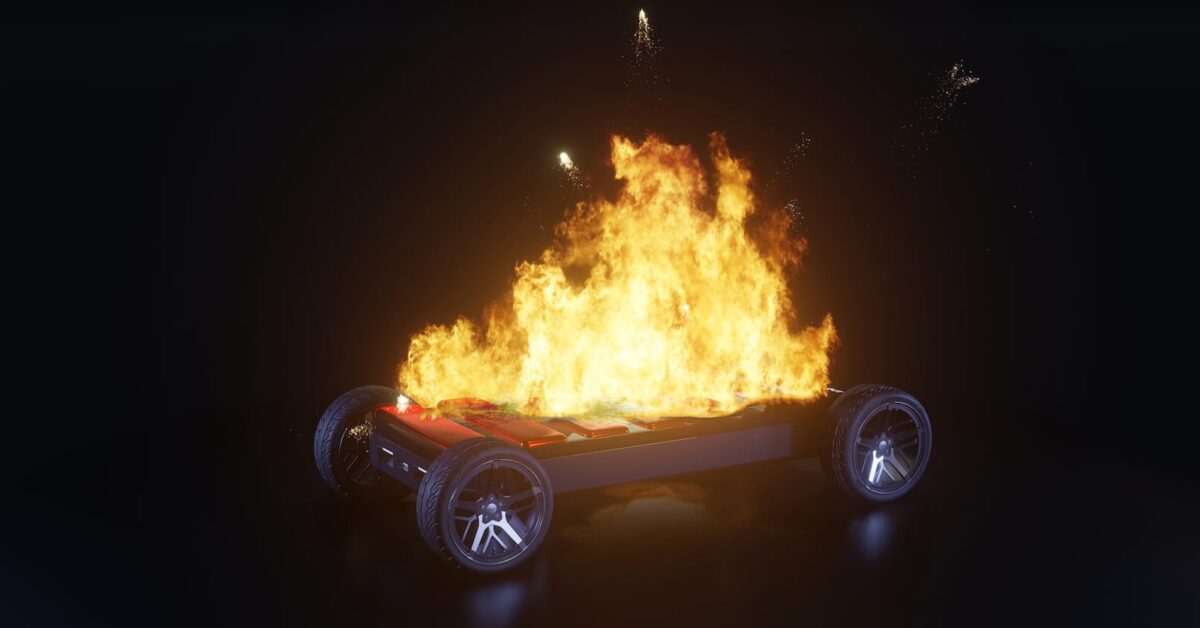
Electric vehicles (EVs) have mushroomed in popularity in recent years, despite attracting plenty of negative headlines. And while most of these scare stories are steadily being debunked, the one that refuses to go away is that EVs are more likely to catch fire than ‘fossil-fuel’ (petrol or diesel)-engined vehicles.
In the early days potential EV buyers experienced ‘range-anxiety’– that dread of being stranded in the middle of nowhere with a flat battery and nowhere to plug it in – but now many EVs have ranges comparable to those of traditional cars. Meanwhile ‘charge anxiety’ – a fear of not being able to find a working plug-in point when you need to charge – is slowly being put to bed by mass roll-outs of new charging facilites.
The one EV fear that refuses to go away, however, is the claim that they’re much more likely to catch fire than are traditional combustion-engined vehicles. Pictures of electric car fires pop up regularly on social media, usually showing a flaming or burnt-out Tesla somewhere in America, with the caption “Look how dangerous electric vehicles are!”
Recently those fears have been stocked by some news outlets seizing on figures showing that electric vehicle fires mushroomed over the last couple of years – but all is not as it may seem, as we shall see shortly.
The fact is that EV fires are an urban myth – research into actual cases has shown that EVs are much less likely to combust than their petrol or diesel equivalents. That’s not to say that all those pictures on social media never happened; you just don’t see an equivalent number of photos of petrol cars burning to the ground…
However it’s not all good news. When an EV does go up in flames, it presents a far trickier proposition for the emergency services trying to extinguish the blaze.
Most of the noise surrounding electric car fires comes from people who are very vocal about their absolute opposition to EVs and the phasing out of petrol and diesel cars. At best, their concerns stem from a lack of understanding of electrically-powered equipment as a whole.
We’ve all had electrical appliances we’ve had to chuck away after the batteries – likely left in far too long – corroded all over their contacts. And a fair few of us have likely experienced an overloaded plug overheating and melting.
With electric cars boasting huge high-voltage battery packs mostly composed of lithium-ion cells, it’s perhaps no surprise that such fears transfer to them and are ramped up to life-threatening level. But evidence of the risk of electric car fires suggests the exact opposite.
Long odds
The figures simply don’t support the narrative, instead showing that the odds of suffering a fire in an EV are much longer than if driving a petrol or diesel car.
Data sourced from UK fire services revealed that in 2022-23 there were more than 19,000 vehicle fires – more than many might have thought. But of these just 239, 0.24%, involved EVs. As an example in 2023 a Freedom of Information request to Shropshire Fire & Rescue Service revealed that the authority had dealt with one EV fire in three years, in 2020.
In 2022 611,000 vehicle fires were recorded in Sweden of which 23 were EV fires – or 0.004%. Back in the UK the Energy Saving Trust published data in 2025 concluding that EV fire risks were 0.0012%, compared to 1% for petrol or diesel cars.
This data came from globally recognised Australian specialist EV FireSafe, which found that from 2010 to June 2024, across the world just 511 verified EV traction battery fires were recorded. Consider this against the fact that some 14 million new EVs were registered in 2023 alone, bringing total global numbers on the roads to 40 million.
What about those headlines of EV fire risks climbing? They came from a report published in May 2025 by business insurer QBE, which stated that fires caused by lithium-ion batteries had doubled in two years. “UK fire brigades are now tackling at least three lithium-ion battery fires a day, following a 93% surge between 2022 and 2024,” the insurer stated.
However not only did EV numbers on UK roads more than double in this period, the QBE data showed that in 2024 EVs represented only 730 of the 1330 fires linked to lithium-ion batteries, which are used in all kinds of equipment, notably smartphones.
Meanwhile what actually constituted an EV in the figures was open to question. QBE’s figures showed that of those 730 EV fires, electric cars with high-voltage traction batteries accounted for just 232 – the rest were electric bikes and scooters.
For many years fire services often did not differentiate between fossil-fuel and EVs in their vehicle fire data, and while now most of them do, there is evidence that EV data often includes electric scooters, without differentiating them.
E-scooters and bikes have rapidly risen in popularity in recent years, but there have also been major concerns over their batteries, particularly in the cheaper models available. The regulations, battery management and safety features required of the high-voltage batteries in electric cars do not apply to those in e-scooters and there have been several incidences of fires in such vehicles, usually while charging them at home from a standard plug – in the first three months of 2023 alone four fatalities were recorded from e-scooter battery fires.
The BBC asked the Home Office why the data available was not more detailed and specific, and was told: “We are reviewing the incident reporting system and considering the collection of data on fires involving lithium-ion batteries, electric vehicles, e-scooters and e-bikes.”
There are very good reasons why an EV is less likely to catch fire than a petrol or diesel car. An EV has far fewer moving parts (friction between components can be a regular cause of fires, leading to overheating). There is no flammable liquid such as petrol being pumped through the car from the fuel tank, usually at the back, to the engine at the front, and there is no hot exhaust to encourage combustion. Without the extensive cooling systems provided by a radiator, and many litres of coolant constantly circulating through the engine, a petrol car would overheat and potentially catch fire within minutes.
One valid point that the anti-EV brigade frequently brings up is that a petrol car is unlikely to spontaneously catch fire while parked in a garage in the middle of the night – it’s only likely to happen when the car is hot from running. Some EV fires have been known to happen while the car has been parked overnight, thanks to a process called thermal runaway. What’s that, you ask?
Causes of electric car fires
So when an EV does catch fire, why does it happen? The centrepiece is the lithium-ion battery pack. Although this is the same technology that goes into a phone or laptop battery, EVs have sophisticated cooling systems for their battery packs to keep them at optimal temperatures. This prevents them running too hot during recharging or driving, so your car batteries don’t get very hot while working hard, like your phone or laptop can do.
EV fire expert Professor Paul Christensen from the University of Newcastle explained to Air Quality News that all battery packs store large amounts of energy in a very small space, which is why they can get hot.
If the pack is penetrated (such as in an accident), or exposed to excessive heat, or incures some other kind of failure, an internal short circuit can occur.
This short circuit causes excessive heat which cannot be removed as fast as it is being generated, and this leads to a chemical reaction which generates more heat, which accelerates the chemical reaction, which generates more heat… This escalating cycle is called thermal runaway. It can, says Prof Christensen, cause ignition or even an explosion.
Dealing with EV fires
Although electric car fires are very rare, they pose great challenges to emergency services – who are still in the process of learning how to tackle such incidents.
The big issue with EV fires is actually putting them out, as they are very difficult to extinguish and then to keep extinguished, mainly as they do not require a supply of oxygen to keep burning. In a piece reassuring residents in its county that EVs are not a greater fire risk and residents should have no qualms about buying one, Bedfordshire Fire Service did reveal that several EV manufacturers advise that an EV fire should be allowed to burn out by itself in a controlled manner.
If attempts are made to put out an EV fire, the most effective extinguishant is not any kind of foam or such like but water and lots of it – one fire service estimated that anything from 4,000 to 10,000 litres of water could be needed.
Once the fire is out, emergency services have to remain vigilant as the nature of EV battery packs has in the past seen examples of fires reigniting after they were apparently extinguished – sometimes weeks afterwards.
This has raised concerns among such bodies as vehicle recovery services, with increasing instances of fire engines actually following recovery trucks to their destination in case the fire starts again. It has been claimed that a quarter of all fires in scrapyards are caused by spent lithium-ion batteries.
According to Bedfordshire Fire Service, an EV fire can generate more than 100 chemicals, some of which are highly toxic such as carbon monoxide. Fire service protective breathing equipment should be able to cope with such chemicals, but even a light wind can carry pollutants a long way. Of course, a burning petrol car will also release a lot of pollutants into the air as well…
Among the more remarkable measures for tackling EV blazes, a fire service in Denmark has developed a car-sized container which can be lowered off the back of a specially converted truck and a still-smouldering EV lowered into it. The container is then pumped full of water and taken to a safe storage area, where it is left for sometimes several weeks until it is deemed the vehicle is safe.
Certainly the issues of fighting EV fires has raised issues about EV batteris in other areas. Installing EV charging points in such places as underground car parks may need to be reconsidered, while one further worry for those researching EV-related safety is the re-use of lithium-ion battery packs.
End-of-life or written-off EVs will often have their battery packs removed and re-used, often ending up in classic cars converted to run as EVs. With much still to learn about how battery packs react in the latter stages of their life, people should be very cautious before going down this route – particularly as there are plenty of reputable classic car converters in the market using brand-new battery packs instead.
Fire retardants
Although there are relatively few EV fires, car manufacturers are taking them seriously. The EV industry is still young and there’s much still to learn, but battery technology is improving all the time, and alongside this battery safety.
A major recent development has been the blade battery format, first introduced by BYD – while the Chinese manufacturer’s cars are rapidly which becoming familiar on UK roads, BYD has long been the world’s largest manufacturer of rechargeable batteries used in smartphones, tablets and the like.
While a type of lithium-ion battery, the blade unit is built in a different format and employs lithium iron phosphate (LFP), which is less likely to catch fire compared to a traditional unit. BYD has demonstrated this claim by driving nails into its battery packs and heating them in an oven to 300 degrees Celsius.
As the blade-format batteries are cheaper to make and make much less use of rare earth minerals, wider adoption of them in new EVs appears likely.
The existing technology is also under constant improvement, developing measures to contain a fire inside the battery pack for as long as possible, providing the occupants of the car with more time to escape. This is achieved through a host of methods, from ceramic blankets (the same basic technology as used in fireproof document storage boxes) to gels and foam encasing the battery pack.
The big challenge for such technology is to keep pace with the technology advancement of the packs themselves, which is moving at a very fast rate.
China was the first to adopt new regulations focused on thermal runaway, which include a requirement for fire and smoke to contained within the battery pack for at least five minutes after first ignition. Europe produced its own similar regulations in 2023, but manufacturers were already building EVs to meet these requirements to pre-empt the regulation.
Summary
All those involved insist that the answer is not to turn away from the EV but to learn the best way to tackle the rare likelihood of a fire. Experts such as Prof Christensen believe the answer will lie in a number of measures working together, both in the design of the batteries and how a fire is fought. “The last thing I want to do is demonise lithium-ion batteries,” he says. “They are amazing, we’ve seen no battery like them before and they are essential to the decarbonisation of the planet.”
So the conclusion? The chances of your EV catching fire are rare, but if it does, it will be a challenge for the emergency services to deal with, but one which they are rapidly getting to grips with.
There are plenty of good reasons you might not want to buy an electric car – high costs, lack of charging infrastructure, your own driving circumstances, and so on. However, fears of a life-threatening blaze shouldn’t be one of those reasons, because you are much less likely to suffer a fire in an electric vehicle than if you bought a petrol or diesel car instead…
This article was originally published in December 2022, and was updated in February 2026.