Ask people to name a posh car and plenty will immediately reply “Mercedes-Benz”. The German brand has long been renowned as a producer of upmarket machines, and to drive – or especially, own – one was seen as a symbol of success, many years before younger intelopers such as BMW assumed such status.
Mercedes-Benz, along with BMW and Audi, forms the German backbone of the executive car market, their sales dominated by company car users. But the Mercedes history stretches back much earlier than either of its rivals – to the earliest days of motoring, in fact.
While it may enjoy an unmatched heritage, today’s Mercedes-Benz is very much a 21st century manufacturer, with one of the widest line-ups of electric models in the industry.
So who or what is Mercedes-Benz?
Mercedes-Benz can be considered as the company that started the car industry as we know it. German inventor Karl Benz built what is widely considered to be the first proper car in 1886, while only a few weeks later, fellow countryman Gottlieb Daimler fitted a petrol engine to a stagecoach (and had previously invented the motorcycle).
Benz and Daimler were two of the pioneers of the new automobile industry. Daimler cars were branded ‘Mercedes’ from about 1902 (see “A Mercedes fact to impress your friends” below) and, up until the mid-1920s, Mercedes and Benz were great rivals.
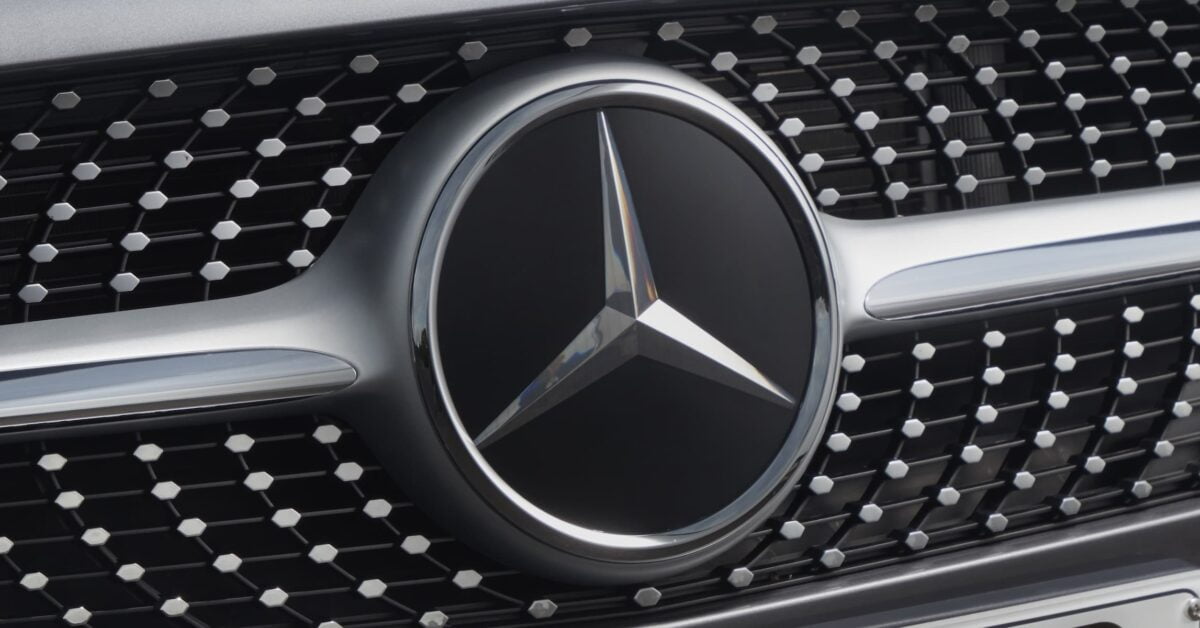
By the 1920s, both Benz and Daimler were in trouble – as was much of the German economy. The two companies merged to form Daimler-Benz in 1926, with the cars branded Mercedes-Benz. The new company’s logo combined Daimler’s three-pointed star with Benz’s laurel wreath, and it remains so nearly 100 years later (although the laurel wreath is not used on most company branding).
As with most of Germany’s large manufacturing companies, things took a dark turn in the 1930s. Mercedes-Benz was heavily supported by the new Nazi government, and a personal favourite of Adolf Hitler – and therefore, favoured by most prominent Germans. After 1937, car production was scaled back as the Nazis directed Mercedes-Benz to focus on lorries and aircraft engines for the military, and the company became one of Germany’s main producers of military equipment until the end of the second world war.
Following the war, Mercedes-Benz re-established itself as a manufacturer of upmarket cars, and its reputation was restored following the launch in 1952 of the 300 SL ‘Gullwing’, today regarded as one of the most valuable and sought-after of classic cars.

While Mercedes enjoyed its reputation as one of the world’s leading ‘premium’ car manufacturers, the company also developed many of the safety innovations we take for granted today, such as crumple zones, anti-lock brakes, traction control and airbags. Laudably, it has made thousands of its patented safety technologies freely available to other car manufacturers in order to improve road safety for everyone.
Although its safety reputation is world-class, some of the company’s business decisions have not been so successful – particularly in its attempt to buy, create or develop brands in addition to the core Mercedes-Benz brand.
In 1998, Daimler-Benz merged with US car manufacturer Chrysler to form DaimlerChrysler, but the marriage was a failure and the American company was offloaded within a decade after huge financial losses. The resultant cost-cutting had a significant impact on the quality of engineering on Mercedes-Benz models of the time, and some company insiders still refer to this time as the “lost decade” for Mercedes.
It partnered with watchmaker Swatch to develop the Smart city car brand, which became very well known but was again never profitable – it’s now a partnership between Mercedes-Benz and Chinese giant, Geely, and has been relaunched as a maker of electric SUVs.
At the turn of the millennium, the company revived the long-dormant Maybach name for a line of limousines to sit above the Mercedes brand and challenge Rolls-Royce in the luxury market. This also failed, and the Maybach name is now used on top-spec Mercedes models instead.
Unlike those efforts, the Mercedes performance brand AMG has been a huge success. Originally a private tuner and racer of Mercedes-Benz cars, the car manufacturer eventually bought the tuning company and created the Mercedes-AMG division. The story of AMG is told in a separate article.
The company is now officially called the Mercedes-Benz Group, with the Daimler name nowhere to be seen. It currently organises its most famous brand into four divisions:
- Mercedes-Benz is the core name for most models with petrol, diesel and hybrid powertrains
- Mercedes-EQ is the company’s rapidly growing electric division
- Mercedes-AMG is the performance division
- Mercedes-Maybach is the top level of luxury for certain S-Class models and occasionally other vehicles
Mercedes-Benz has also built light commercial vehicles for most of its history. Today, it offers a range of vans and even sold a pick-up truck for a while – the short-lived X-Class.
In addition to luxury cars and light commercial vehicles, you can find the three-pointed star on a variety of heavy commercial vehicles. It’s not well known that Karl Benz developed the world’s first truck and world’s first bus, shortly after his passenger car went into production. Mercedes-Benz has gone on to become a leading name in both trucks and buses to this day.
Most recently the company has also announced an ultra-luxurious new brand called Mercedes-Mythos, said to combine the opulence of Maybach with the performance of AMG. The first Mythos, a version of the SL cabriolet, appeared at the end of 2024 with a second hardcore variant of the CLE coupe on the way.
Meanwhile like most of the automotive industry Mercedes is reacting to the worldwide political mood music and slowing its transition to electric-only models, while also steadily dropping the EQ moniker for its electric vehicles – in future they will simply follow the mainstream model lines.
What models does Mercedes-Benz have and what else is coming?
For many decades, the core of the Mercedes-Benz line-up were three ranges of saloons and estates – the C-Class, E-Class and S-Class – while sports car fans were catered for by the SL convertible. Today, however, it has one of the largest model ranges in the industry.
Over the years, Mercedes-Benz has dabbled in almost every style and size of car available – some with more success than others – and with a variety of often-confusing names. Significant rationalisation has taken place in more recent times however, model lines such as the once very popular SLK two-seat cabriolet dropped as the brand focuses on its core saloons and particularly SUVs – today most of the fossil-fuel models come in hybrid form alongside a very wide range of electric vehicles (EVs).
Until recently, further model name confusion was added with the EVs placed in a separate group to their traditional siblings, dubbed EQ. But in the next couple of years these will steadily be brought back into the mainstream model line – so instead of the GLA and EQA, for example, we will have a single new GLA line with the electric model called the GLA-EQ.
The A-Class was launched in 1997 as the first Mercedes small car – it was a brilliantly clever small vehicle, but far too expensive to sell profitably. The current A-Class is a far more conventional five-door hatchback, with a taller B-Class sibling. Recent rumours have suggested both were to be dropped but as of February 2026 they remain on sale.
The conventional triumvirate of saloons, the C-Class, E-Class and S-Class, remain available, the C-Class and E-Class also coming in estate form. Both have spawned coupé versions known as the CLA and CLE, while the CLA also comes as an estate, dubbed a ‘Shooting Brake’ because of its more curvy rear profile. And just one drop-top remains in the Mercedes line-up, the CLE Cabriolet.
Current ‘A’-rated Mercedes-Benz models in our Expert Rating Index
For those who need loads of space, there’s a van-based eight-seater MPV called the V-Class.
Mercedes followed the industry rush to SUVs, with its first model being the hugely successful M-Class, which subsequently became the GLE in one of the company’s many model-name changes. Today, you can choose between the GLA, GLB, GLC, GLE and GLS in order of increasing size, and there are also coupé-SUV variants of the GLC and GLE.
The G comes from G-Class, an old-school 4×4 that rivals Land Rover for its go-anywhere ability. It was first developed as a military vehicle in 1970, before being reinvented as a luxury model but without losing any of its off-road prowess. Today it is still available, but starts at more than £140,000…
Mercedes offers a very wide range of EVs – as of February 2026 you can have the CLA EQ, EQE and EQS saloons (the CLA also offered as a shooting brake), the EQA and EQB crossovers, SUV variants of the EQE and EQS and the ‘EQ’ versions of the more traditional GLB and GLC SUVs. Even the proper off-roader G-Class and the V-Class people mover now come in electric form.
Turning to what’s coming next, without doubt the most important new Mercedes-Benz on the way is the new C-Class – the BMW 3 Series rival will arrive sometime in 2026 as the C-Class EQ – it will only be available in electric form.
Topping a host of SUV launches will be an electric version of the best-selling Mercedes in the class, the GLC. It will be joined by a third-generation GLA with both petrol and electric drivetrains, and a second-generation GLB which offers seven seats.
Mercedes models generally remain highly regarded by reviewers and owners, with the majority earning ‘A‘ and ‘B‘-level scores in The Car Expert’s industry-leading Expert Rating index. Only the G-class SUV and V-class people carrier truly let the side down with ‘D‘ and ‘E‘ ratings respectively, the former primarily on its cost and the V-class dubbed poor to average in virtually every category.
Where can I try a Mercedes-Benz car?
Mercedes-Benz is an upmarket ‘premium’ manufacturer and you won’t find a dealership in every town – in fact the brand has taken much closer control of its dealer operation in recent times and cut its number of outlets. But with close to 140 dealerships well spread across the UK, you won’t have to travel too far to test drive a Mercedes.
The company also has a flagship centre called Mercedes-Benz World, opened in 2006 on the former Brooklands race track in Surrey. Designed to be as much a family day out as a dealership, the facility offers driving experiences in Mercedes-AMG performance cars on a specially designed track and skidpan, and in 4×4 models on a purpose-built off-road course. There are also three floors of displays and exhibitions, as well as showrooms for new and used cars.
Mercedes-Benz Vans dealerships are usually separate to the passenger car dealers, although there are some sites that sell both.
What makes Mercedes-Benz different to the rest?
Amazingly, Mercedes-Benz – through its two founders – can legitimately claim to be responsible for giving the world the motor car, the van, the truck, the bus and the motorcycle.
The company has long enjoyed a reputation for outstanding engineering. Although this took a hit during the DaimlerChrysler years, Mercedes has worked hard to re-establish its engineering excellence over the last decade. Among ‘legacy’ car companies, it’s also one of the leading adopters of electric vehicles.
Janis Joplin famously sang “Lord, won’t you buy me a Mercedes-Benz?”, neatly illustrating the enduring reputation and appeal of the three-pointed star. Today, cars of the premium sector are not nearly as exclusive as they once were, and Mercedes-Benz – along with Audi and BMW – is one of the most popular car brands in the UK (it was the ninth best-selling brand in the UK in 2025, out of more than 50 brands, outselling mainstream names like such as Skoda, Peugeot and Renault among others.
Despite increasing familiarity of the three-pointed star on UK roads, owning a Mercedes-Benz is still considered special for many car buyers.
A Mercedes-Benz fact to impress your friends
The name ‘Mercedes’ has nothing to do with either Daimler or Benz, but it became the brand name for Daimler’s cars from the early 1900s onwards and has survived through until today.
One of the Daimler company’s early distributors was a German entrepreneur living in the south of France, named Emil Jellinek. He sold and raced cars from a variety of manufacturers under the brand name Mercedes, named after his daughter Mercédès Jellinek. Back in the 1890s, you could have bought a Peugeot-Mercedes, a De Dion-Mercedes or even a Benz-Mercedes from Jellinek’s garage in Nice.
Jellinek commissioned a sports car from Daimler to his own demanding specifications, and the resulting Daimler-Mercedes became a huge success – so much so, that Jellinek ended up on the Daimler board and the company adopted the brand name Mercedes for all its cars.
When Daimler merged with Benz in 1925, the company became Daimler-Benz and its cars were branded Mercedes-Benz.
Jellinek was a superstitious man, and believed that the name Mercedes brought him luck. He named almost all of his personal and business interests Mercedes for the rest of his life, and even changed his own name to Emil Mercedes in his later years.

The name ‘Mercedes’ has nothing to do with either Daimler or Benz, but it became the brand name for Daimler’s cars from the early 1900s onwards and has survived through until today.
One of the Daimler company’s early distributors was a German entrepreneur living in the south of France, named Emil Jellinek. He sold and raced cars from a variety of manufacturers under the brand name Mercedes, named after his daughter Mercédès Jellinek. Back in the 1890s, you could have bought a Peugeot-Mercedes, a De Dion-Mercedes or even a Benz-Mercedes from Jellinek’s garage in Nice.
Jellinek commissioned a sports car from Daimler to his own demanding specifications, and the resulting Daimler-Mercedes became a huge success – so much so, that Jellinek ended up on the Daimler board and the company adopted the brand name Mercedes for all its cars.
When Daimler merged with Benz in 1925, the company became Daimler-Benz and its cars were branded Mercedes-Benz.
Jellinek was a superstitious man, and believed that the name Mercedes brought him luck. He named almost all of his personal and business interests Mercedes for the rest of his life, and even changed his own name to Emil Mercedes in his later years.
Summary
Mercedes-Benz has always been an upmarket marque, and while rivals such as Audi and BMW have in more recent times provided huge challenges to that status, driving a car with a three-pointed star badge is still today regarded as something special.
With one of the most recognisable badges around now appearing on an extensive range of electric cars, there are many more headlines still to be written about Mercedes-Benz.
Buy a Mercedes-Benz
If you’re looking to buy a new or used Mercedes-Benz, The Car Expert’s partners can help you find the right car.
Lease a Mercedes-Benz
If you’re looking to lease a new Mercedes-Benz, The Car Expert’s partners can help you find a competitive deal.

Personal contract hire deals from Carparison Leasing. Find out more

Personal contract hire deals from Rivervale Leasing. Find out more
This article was originally published in March 2024, and was updated in February 2026.