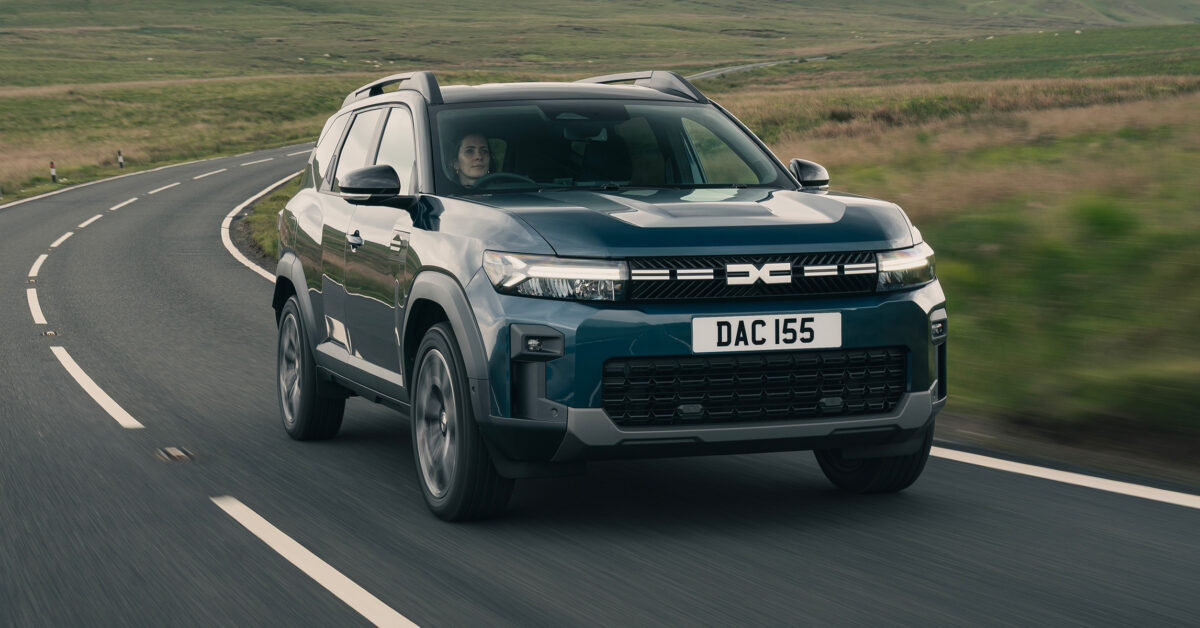
Make and model: Dacia Bigster Journey HEV
Description: Petrol-electric hybrid SUV
Price range: £26,765 (plus options)
Dacia says: “A modern, streamlined design boldly highlights Bigster’s ruggedness, while its spacious, well-equipped interior ensures you travel in comfort every day!”
We say: Cheap, boxy, excellent on fuel and practical.
Introduction
The Dacia Bigster follows in the Duster’s popular footsteps. While the Duster is similar in size to the MG ZS and Renault Captur, the Bigster is aimed at buyers of the Ford Kuga and Nissan Qashqai.
What is it?
As its name suggests, the Bigster is the largest car in Dacia’s line-up. It’s over 22cm longer than the Duster and has an additional 4cm of rear knee room. However, its other dimensions are identical to its sibling; think of the Bigster as a stretched Duster.
It’s a family SUV that can be equipped with a hybrid powertrain and four-wheel drive, if you desire. It’s designed to be affordable while still offering a reasonable level of kit.
Being affordable, the material quality is sometimes questionable, so don’t expect soft-touch plastics or fancy leather.
Who is this car aimed at?
As good as it is, the Nissan Qashqai is quite expensive, limiting options for those who don’t need anything overly fancy. And while the Dacia Duster ticks the cheap small family SUV boxes well enough, having the option of an even bigger car means larger families can get on board for only a few grand more.
It’ll also suit those who venture off the beaten path and don’t mind crushing mud into their carpets. It suits my dogs and me perfectly; the saliva can be easily cleaned, and mucky dog paws can be washed off the Bigster’s rubber boot liner, if you equip it.
Who won’t like it?
Those coming from a Nissan Qashqai or Kia Sportage might find the Bigster too cheap in places and lacking the usual digital creature comforts. That doesn’t mean it has a stripped-back 1970s-style cabin, but its systems aren’t as finely tuned as those found in the Nissan or Kia.
Similarly, those who value cabin quality should look elsewhere. The cabin is filled with scratchy plastics and cheaper materials, but this is a sub-£25k car, after all. Scratchy plastics and cheap trim aside, the Bigster feels quite robust in the places that matter most.
First impressions
It’s good-looking, but because the Bigster is a relatively new name, I found people confused it with the almost identical and cheaper Duster. Not that it should annoy you, as the Duster’s great, but this is the brand’s flagship and it’s difficult to see that from the outside.
It’s not until you start filling its boot with shopping, dogs, prams, and junk that you realise where the extra cash goes, as the way the Bigster’s boot space can be utilised is mesmerising. Don’t get me wrong, the Duster does this job well, but the Bigster does it much better, and you’ll swear less when trying to fit larger items into the car’s boot.


What do you get for your money?
There are three trim levels: ‘Expression’, ‘Journey’, and ‘Extreme’, but all versions of the Bigster come loaded with reasonable levels of tech as standard.
Even the entry-level Expression, costing £25.2K, has a 360-degree camera to help with parking in confined spaces, as well as electrically folding mirrors, wireless smartphone connectivity, traffic sign recognition, blind-spot monitoring, cruise control, lane-keep assist, and keyless entry.
Spending an extra £1.5K gets you the Journey, which includes dual-zone climate control, an electronic parking brake, 20/40/20 folding rear seats and a powered tailgate.
The range-topping Extreme includes everything the Journey model offers, plus some unique design elements, a panoramic sunroof, modular roof bars, and an upgraded entertainment system.
Optional extras include roof boxes, interior storage, rubber mats, a pet pack, camping kits, blackout blinds and side steps.
If you plan to take the Bigster off-road, note that the four-wheel-drive system is only available with a petrol powertrain, not the hybrid version, and is only offered on the Expression and Extreme trims.
We like: simple powertrain and trim list. Decent standard tech. Four-wheel drive option
We don’t like: What’s meant to be a cheap car can quickly become expensive after a few options are applied.
What’s the Dacia Bigster like inside?
Whether you’re planning an off-road camping trip or a countryside road trip, the Bigster will have your back with a can-do attitude. And although its utilitarian exterior is carried inside the cabin, it’s nowhere near as extreme as, say, a Jeep Wrangler.
It’s filled with hard plastics, which are easy to wipe down after being in contact with muddy feet or paws.
If you’re familiar with the Duster’s interior, then the Bigster will feel no different, as this is just a long-wheelbase variant. And while that’s good in some areas, it’s not great in others. For example, the car’s multimedia screen can be woefully slow at times, especially when inputting sat-nav directions. This aside, the graphics are blocky and vibrant, and it’s fairly easy to use.
The cabin is also filled with a decent number of physical switches, meaning you’ll spend less time faffing around with the annoying touchscreen. And if, like me, you prefer Android Auto or Apple CarPlay to manufacturer systems, the Bigster supports them as well.
Comfort is where the Bigster falls flat. It’s not terrible, and you won’t require a chiropractor, but I found it hard to get comfortable on longer motorway runs. This could also be because I suffer from a bad back, but regardless.
We like: Physical switches, wipeable interior, and phone connectivity.
We don’t like: Touchscreen is sometimes slow. Not that comfortable.


What’s the Dacia Bigster like to drive?
Luckily, Dacia hasn’t given the Bigster the Duster’s woeful turbocharged 1.0-litre. Instead, there are three engines to choose from: a 140hp petrol unit, a 155hp petrol/electric hybrid, and a 130hp petrol unit with four-wheel drive. Both the petrol engines have mild hybrid assistance, but they can’t run on electrical power alone like the 155hp hybrid powertrain.
The engine tested here is the 155 hybrid. A 1.8-litre petrol engine is assisted by an electric motor to drive the wheels plus a smaller electric motor like the one in the mild hybrid units. All the power is sent to the front wheels, unlike some companies that use a hybrid system to provide four-wheel drive.
On longer motorway runs, my Bigster Journey 155 returned an average of about 60mpg, while mixed runs were closer to 55mpg. However, a fair bit of wind noise enters the cabin at motorway speeds.
Being a hybrid, this model only comes with an automatic gearbox. Unfortunately, it’s overly complicated and quite clunky to use. This means that the 155’s straight-line punch is hindered when you need to overtake, as sinking the throttle results in a large delay before it takes off.
We like: Good economy in all driving situations
We don’t like: Noisy at motorway speeds, clunky gearbox
How safe is the Dacia Bigster
As chunky and utilitarian as it may seem, the Bigster scored just three stars during Euro NCAP’s testing. This information was pulled from the Duster’s 2024 testing, as they are essentially the same car.
Safety has been a weak point for Dacia over the years. Three stars for the Bigster and Duster doesn’t sound great (and it’s not) but they’re the best performers in the Dacia family – the Sandero models only score two stars, while Jogger and Spring get an abysmal one-star score each.
Dacia argues that its customers don’t want expensive safety systems, but the reality is that even similarly priced models from Chinese brands do much, much better.


Verdict
The Dacia Bigster is a jack of all trades. It’s not only a family car, but can also be an off-road campervan, a tool mover and a trailer hauler. And unlike many of its rivals, it’s affordable, even in range-topping form.
The entry-level 140hp model is good, but we recommend stepping up to the 155 hp model, as it offers a bit more punch and improved fuel economy.
You’ll struggle to get a better car for the money that offers as much room, standard equipment and efficiency. The only real let-down is a sub-standard safety rating, although it obviously exceeds all the basic legal requirements. But if you don’t mind sacrificing a few creature comforts, the Dacia Bigster is a solid choice.
Similar cars
Citroën C5 Aircross | Ford Kuga | Honda CR-V | Hyundai Tucson | Jeep Compass | Kia Sportage | Mazda CX-5 | Mercedes-Benz GLA | Mercedes-Benz GLB | MG HS | Nissan Qashqai | Nissan X-Trail | Peugeot 3008 | Renault Austral | SEAT Ateca | Skoda Karoq | Suzuki S-Cross | Toyota C-HR | Vauxhall Grandland | Volkswagen Tiguan
Key specifications
Model tested: Dacia Bigster Journey hybrid
Price as tested: £26,765
Powertrain: 1.8-litre petrol/electric hybrid
Gearbox: Six-speed automatic
Power: 155 hp
Torque: 172 Nm
Top speed: 112 mph
0-62mph: 9.7 seconds
Fuel efficiency: 58 mpg
CO2 emissions: 106 g/km
Euro NCAP safety rating: Three stars (May 2025)
TCE Expert rating: B, 65% (February 2026)
Buy a Dacia Bigster
If you’re looking to buy a new or used Dacia Bigster, The Car Expert’s partners can help you find the right car.