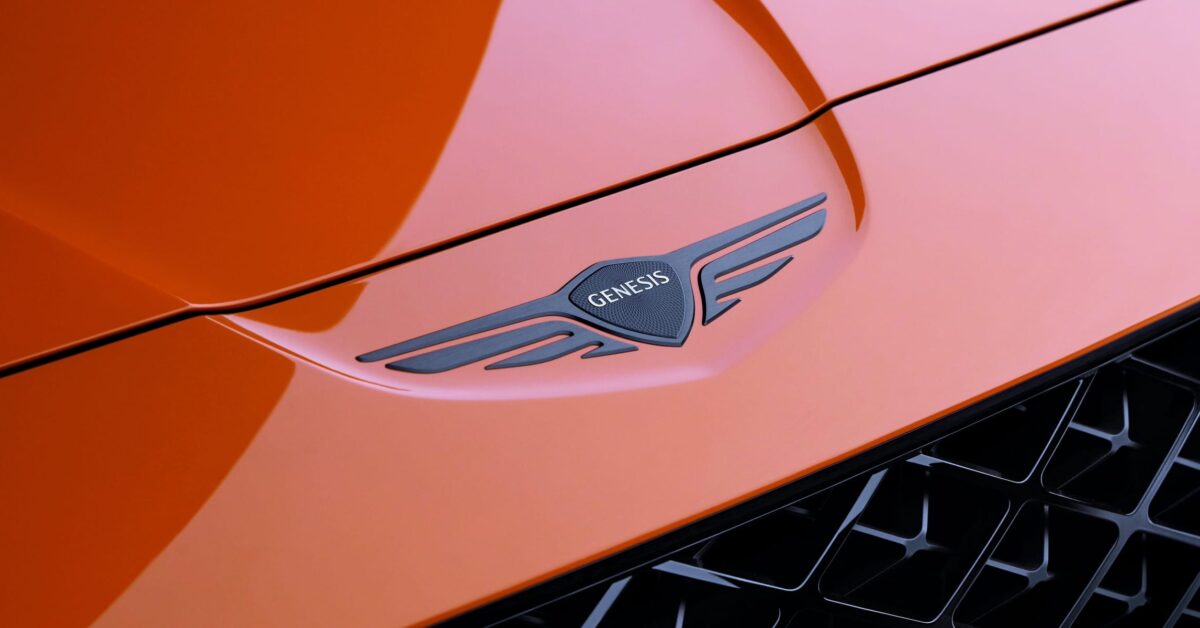
For many years and depending on your age and/or religious beliefs, the name Genesis likely meant either a British rock band or the first book of the Bible. But since 2021 Genesis has also been an automotive brand on sale in the UK, a premium offspring from South Korean brand Hyundai.
As of January 2026, Genesis has a range of models covering mid-to-large luxury cars. While currently focusing on electric models, some of its petrol and diesel variants are still available.
So who or what is Genesis?
Genesis is a premium car brand from Korea and forms part of the Hyundai Group, sitting above Hyundai and Kia in the family. The name started life as a Hyundai luxury saloon launched in 2008, before evolving into a separate brand in 2015. Although its cars are largely based on mechanical bits shared with those two brands, there’s a lot of individual design and technology.
Building a premium brand over the top of mainstream mechanicals is certainly not a new idea in the car industry. Fundamentally, many Audis are little more than posh Volkswagens, while most Lexus models are trussed-up Toyotas. Similarly, Nissan created the upmarket Infiniti division (now gone from Europe but still doing well in the USA), and Citroën spun off its top-spec DS models into the standalone DS Automobiles brand.
It’s fair to say that the market performance of new premium brands from Asian companies has been rather mixed, with cracking Europe proving most challenging.
Lexus was launched by Toyota in the late 1980s and has become a firmly established name, but it still sells in relatively small numbers in Europe. Infiniti was Nissan’s attempt to do the same thing, but despite success in America and China, the brand lasted little more than a decade in Europe before abandoning the idea.
Hyundai is keen to describe the launch of Genesis as a success, the brand passing 1.5 million global sales in its first decade, faster than rivals such as Lexus or Tesla. But most of these sales have been in its home market of Korea and making European progress has been more challenging – so far little more than 5,000 cars have been sold in the UK.
The Genesis growing pains saw the brand taken more firmly under the wing of its parent Hyundai in 2024, and the original embracing of three of the biggest new themes of car selling in the 2020s – only making electric vehicles, online sales and car subscriptions, have been vastly rolled back in recent times.
In a twist the brand announced in 2025 that its existing petrol and diesel models would not be restocked in the UK once sold out, but that future Genesis models will include hybrid and range-extender drivetrains. Meanwhile a shift to a more traditional sales model has seen a clutch of traditional dealers signed up.
Yet after a couple of years where its future in Europe was questioned, Genesis has come out fighting – the brand celebrated its 10th anniversary at the end of 2025 with the launch of Magma, a performance arm that will see Genesis take on the likes of BMW M and Mercedes-AMG with more potent versions of its road cars.
Magma will be promoted in an expensive manner – a specially built hypercar will take on the renowned Le Mans 24 Hours endurance race in 2026 as according to design head Luc Donckerwolke Genesis evolves into a “luxury high performance brand”.
When did Genesis launch in the UK?
The company launched in the UK in summer 2021, and quickly expanded its range to encompass eight variations. Initially they were petrol and diesel powered before Genesis more heavily focused on electric vehicles – only to follow the industry trend of rolling back its future all-electric aims with plans for new hybrid and range-extender models.
What models does Genesis have and what else is coming?
Genesis UK effectively took the axe to its model range in 2025, stating that it would not restock dealers with its petrol or diesel cars, leaving just the three electric vehicles in the range. However as of February 2026 the Genesis website still lists the fossil-fuel models and if you are not yet quite ready to go electric you may still find dealer stock.
The standout of these remains the GV60, the first Genesis model designed from the ground up as an electric vehicle – the electric versions of its GV70 mid-size SUV and G80 large saloon were effectively converted from their conventional fossil fuel siblings.
Recently significantly updated with its official range extended close to 350 miles, the GV60 has earned highly favourable reviews and enjoys a New Car Expert Rating of A, with a score of 76% in The Car Expert‘s industry-leading Expert Rating Index.
The Electrified version of the GV70 also holds a New Car Expert Rating of A, with a score of of 74%. This is a mid-size SUV pitched against the BMW X3, Audi Q5, Mercedes-Benz GLC, Volvo XC60, Land Rover Discovery Sport, Jaguar F-Pace, Lexus NX and about a million others.
The original fossil-fuel version is not nearly as highly regarded, poor running costs and middling media reviews restricting it to a New Car Expert Rating of C, with a score of 63%.
One model that has not been electrified, principally because it would then rival the G60, is the G70 mid-size saloon and estate (‘Shooting Brake’). It’s similar in size to the BMW 3 Series, Audi A4, Mercedes-Benz C-Class, Jaguar XE, Volvo S60/V60 and others, and earns a New Car Expert Rating of C, with a score of 64%. It’s marked up for safety levels but down for poor running costs and less than complimentary media reviews.
The G80 large saloon is is the G70’s big sister and takes on up against the BMW 5 Series, Audi A6, Mercedes-Benz E-Class, Jaguar XF, Volvo S90, Lexus ES and so on. Both the Electrified and petrol/diesel versions return similar scores to the GV70 – A level for electric, a modest C for the fossil fuel option.
The large Genesis SUV, the GV80, was one of the first vehicles to be dropped. Pitched to compete with the likes of the BMW X5, Audi Q7, Mercedes-Benz GLE, Volvo XC90, Land Rover Discovery, Lexus RX and more, it impressed few, only praised for its safety and earning a paltry New Car Expert Rating of D, with a score of 59%. It only sold around 200 examples in three years.
The next Genesis model, expected on sale sometime in 2026, will be a range-topping large SUV, the GV90. It will be an EV pitched as a luxury model with six seats.
Otherwise the new model focus in the next few years will be angled firmly towards the new performance Magma cars, which in standard form come with a head-turning bright orange paint scheme. Genesis intends eventually to offer Magma versions of every one of its models.
Magma launches with the GV60, intended to rival the Porsche Macan and the N version of parent brand Hyundai’s Ioniq 5. The G70 and G80 will also soon get the Magma treatment, while an all-new coupe variant of the GV60 is also on the way as likely a Magma model.
Also coming before long will be the Magma GT, a mid-engined supercar intended to rival the likes of McLaren. It will be offered in a range of versions but will only be available as a Magma.
In the longer term Genesis could expand its model range with a luxury 4×4 vehicle rivalling the products of Land Rover. The X Gran Equator was shown as a concept at the New York Auto Show in April 2025, and could reach production by 2030.
Where can I try a Genesis car?
The growing pains of Genesis in Europe have included abandoning its original intention to only sell cars directly to the public rather than through conventional dealerships. Originally everything was done online but the brand did set up physical ‘studios’, two in London at Westfield shopping centre in West London and the Battersea Power Station, and a third set to open shortly in Edinburgh.
They have more recently been joined by ‘retail partners’ – traditional dealers mostly with groups who already represent Hyundai. So far these have opened in Ashford in Kent, Cannock, Glasgow, Guildford, Leeds, Leicester and Warrington, and could eventually reach around 20 outlets.
What’s particularly significant about this company?
Despite many changes to its sales strategy since launching in 2021, Genesis has retained its holistic approach to car buying and ownership, managing the journey from start to finish rather than outsourcing car sales and servicing to franchises.
The company calls this philosophy “The Genesis Difference”. It includes fixed new car pricing, a choice of finance options including car subscriptions, and a standard five-year care plan that includes warranty, breakdown cover and all scheduled servicing. There’s also a concierge-style service to book test drives, deliver your new car, collect it for servicing (along with a courtesy car) and so on.
Naturally, all these inclusions are reflected in the cars’ prices. But if you’re the sort of person that hates the ongoing time and cost burdens of managing your car, it takes most of that off your hands.


What makes Genesis different to the rest?
Genesis initially took a different route to other premium car companies, emphasising luxury and comfort rather than pseudo-sportiness. Its ‘personal assistant’ concierge service will certainly appeal to high-earning customers with little time or inclination to handle the mundane logistics of owning and running a car.
The ‘Sport’ trim levels of the Genesis range have been largely cosmetic rather than the usual combination of body-hugging seats and rock-hard suspension settings that combine to pummel your kidneys and rattle your teeth on UK roads.
What we don’t know yet is just how just how luxurious and comfortable the new Magma range will be, a line-up pitched entirely on performance.
Summary
Cracking the premium car market is tough, as many brands have found over the years. While several new brands have tried, the latest being a host of Chinese brands, the German troika of Audi, BMW and Mercedes-Benz still dominate sales numbers (in 2025, BMW was the second biggest brand in the UK, beaten only by Volkswagen), while every other fights over the scraps.
Unsurprisingly, Genesis is still very much on the fringes of the new car market. Five years after going on UK sale its annual sales are only about 1% of BMW’s, so you’re not going to see too many of them on your daily commute anytime soon.
Still, the company has quickly established itself as a credible alternative to the traditional options. Its electric models gain high-scoring reviews and it offers a customer experience distinctly different to the mainstream.
The brand name might still fly under the radar for most people but, if it can target well-heeled customers who are not hung up on a German brand name, there are plenty of opportunities for continued growth. Parent company Hyundai is firmly behind its new brand, and looks to have learned from the difficulties faced by other premium start-up brands over the years.
If you’re not a car enthusiast and simply want a luxurious car that whisks you around smoothly in quiet comfort, a Genesis could be right up your street.
Additional reporting by Stuart Masson