Regular readers may wonder why this series is focusing on Mitsubishi. The Japanese manufacturer was a familiar name on our roads for close to half a century until it exited the UK market in 2020. Well, it seems that Mitsubishi is now coming back…
Even among seasoned industry observers, no one had “Mitsubishi to return to the UK” on their bingo cards for 2025. Yet an official announcement out of the blue in November confirmed that we would see new Mitsubishis on UK roads by the summer of 2026 – a remarkable U-turn in such a short space of time.
Five years ago, Mitsubishi was facing huge losses and enduring the worst European sales performance in its long history – just when significant investment was needed to meet growing environmental demands and the inevitable shift to electric vehicles. So it was not particularly surprising that the company decided it was not worth continuing to sell its cars in Europe.
Although Mitsubishi announced that it was completely exiting Western Europe, it never quite did. In several European countries, you have still been able to buy a handful of different Mitsubishi models – generally lightly rebadged versions of Renault or Nissan models, as Mitsubishi is part of a global three-way alliance with both brands.
Over the last few years, selling cars in the UK has got even more complicated – the environmental pressures haven’t gone away, Brexit has added further complications, EV adoption has become pressured (although the underlying direction of travel has not changed), and now a load of new Chinese brands have arrived in Britain, aggressively seeking their slice of the car-buying pie.
All of which makes it very surprising that Mitsubishi is reversing its earlier decision. So what can we expect? Read on…
So who or what is Mitsubishi?
Mitsubishi Motors is just one part of a giant conglomerate that was once Japan’s largest industrial group, and has a history dating back to the 1850s.
The automotive story began in 1917 when Mitsubishi Shipbuilding Co launched the first production automobile in Japan. Inspired by a Fiat, the car was called the Model A and offered seven seats. It was a luxury vehicle, entirely built by hand and as a result was expensive – just 22 were made over four years.
In 1934, Mitsubishi Shipbuilding merged with Mitsubishi Aircraft Co to become Mitsubishi Heavy Industries, Japan’s largest private company. Its prime business was aircraft, ships and rail vehicles, but in 1937 it launched a saloon car called the P37. The first Japanese car with all-wheel drive, it was aimed at the military. In the second world Sar, Mitsubishi was a prime supplier of military hardware, with the Mitsubishi Zero fighter plane being the Japanese equivalent of Britain’s Spitfire or Hurricane.
After the war, the occupying Allied powers forced Mitsubishi to be split into three. From 1951, one of the trio, East Japan Heavy Industries, imported a budget American car called the Kaiser Motors Henry J. It was supplied as a kit of parts that was assembled in Japan.
This deal lasted for three years, but a similar one involving Jeeps secured by another of the trio, Central Japan Heavy Industries, lasted rather longer – all the way through until 1998. In 1953 the firm, now known as Shin Mitsubishi Heavy Industries, added its first home-built car.
The Mitsubishi 500 was a saloon designed for large sales and was quickly followed by the Minica – an example of the tiny and low-powered ‘kei cars’ unique to Japan, and then the Colt 1000, the first to use a name that was to become synonymous with Mitsubishi product.


In 1964, the three companies were re-merged back into Mitsubishi Heavy Industries, and car production rapidly expanded to more than 75,000 vehicles annually, alongside similar growth in its commercial vehicle market. A specific automotive company, Mitsubishi Motors, was founded in 1970.
The new company pursued expansion by doing deals with major global car makers, and from 1971 Chrysler took a 15% stake, selling Galant models in the USA. Soon, the Europeans were also buying Mitsubishis from dealers branded as Colt – in the UK, the Colt Car Company was established in 1974. By 1980, Mitsubishi’s annual production had exceeded one million cars.
The car maker went public in 1988, with Mitsubishi Heavy Industries owning 25% and Chrysler increasing its stake to 20%. Sales of SUVs were beginning to take off, particularly in America, and Mitsubishi dusted off its experience in all-wheel-drive powertrains to take full advantage.
The manufacturer was riding so high that in 1993 it was rumoured to be about to make a hostile takeover of Honda, which had underestimated the SUV boom, although nothing came of it. But then things started to go wrong.
Chrysler, itself not in a healthy state, had ended its investment in Mitsubishi in 1993 and the Japanese maker sought other alliances. Then came a major product recall in 1999, during which the company was accused of hiding a wide range of manufacturing defects, which erupted into a national scandal in Japan. In 2005, Mitsubishi Heavy Industries led a rescue of the car maker that cost 540 billion yen – equivalent to around £2.7 billion or £4.8 billion today.
The recovery was swift, Mitsubishi returning to profit by 2007 and securing contracts to make cars for both Nissan and PSA Group, parent of Peugeot and Citroën. This lasted until another scandal – Nissan uncovered discrepancies in the stated fuel consumption of some Mitsubishi cars and what they actually used. The ensuing furore paved the way for Nissan to acquire a 34% controlling stake in Mitsubishi in 2016, and to integrate the maker into the Renault–Nissan Alliance.
Mitsubishi remained reasonably strong in its home market, but in Europe it was a different matter. In 2020, as part of a global cost-cutting initiative by partners Nissan and Renault, it was announced that Mitsubishi would need to cut fixed costs by 20% and “focus investment on core markets”.
European profits at Mitsubishi were said to be at their lowest-ever level as the Covid pandemic halved UK sales from 2019 to 2020, just as expensive investment would be needed to address future challenges. As a result, it was decided to freeze development of new models for Europe and quit UK sales altogether – a move that took Mitsubishi’s UK operation totally by surprise.
The brand’s after-sales business was acquired by IM Group – a company that also manages the UK interests of Subaru, Isuzu, GWM and Xpeng – with more than 100 dealers around the UK to look after existing Mitsubishi customers.
The understanding from inside the industry is that IM Group is the driving force behind Mitsubishi’s UK return, rather than any great pressure from the company’s head office in Japan.
What models does Mitsubishi have and what else is coming?
Mitsubishi has yet to reveal the full details of the future UK model range, though we do know the first two cars heading to Britain.
Core to the relaunch will be the latest version of the Outlander plug-in hybrid SUV. This will be the latest version of a model that had brought Mitsubishi considerable success in the 2010s as one of the first cars to offer a plug-in hybrid powertrain to UK buyers. The current model sold in Europe was jointly developed with the latest Nissan X-Trail.
Also coming back is the newest version of the L200 pick-up, which had previously been a favourite amongst tradespeople and farmers.
Used Mitsubishi range on our Expert Rating Index
Beyond those two models, the company’s plans are currently unclear. Mitsubishi still sells a number of models in Europe, such as the Colt (a rebadged Renault Clio), ASX (a rebadged Renault Captur), Grandis (a rebadged Renault Sumbioz) and electric Eclipse Cross (a rebadged Renault Scenic).
Of these, the Eclipse Cross electric SUV seems a logical choice as the company will need electric models to hit the UK’s zero-emissions vehicle mandate targets, and the Eclipse Cross is based on the highly rated Renault Scenic – winner of The Car Expert’s Best Medium Car 2025 award and also the European Car of the Year 2024 award.
Where can I try a Mitsubishi car?
Again, watch this space. The return to UK sales means Mitsubishi needs to set up a dealer network to sell them, and details on this are currently sparse.
With IM Group managing four other car brands, it’s highly likely that we will see Mitsubishis popping up in some existing Subaru, Isuzu, GWM and Xpeng showrooms.
A Mitsubishi fact to impress your friends
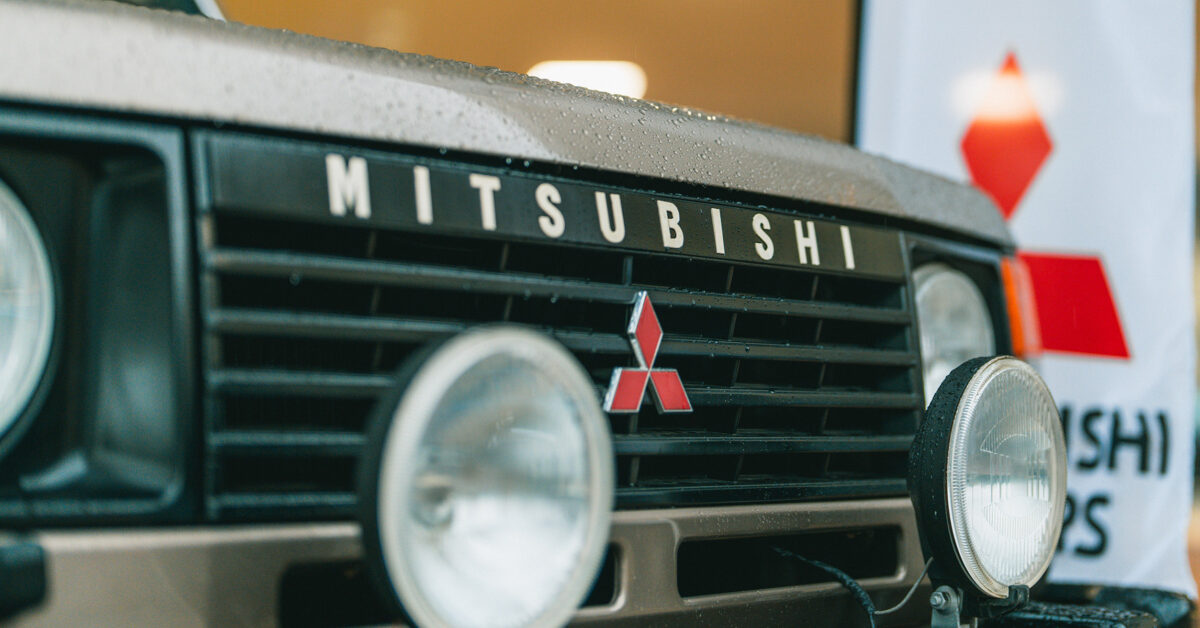
Mitsubishi’s origins pre-date its car manufacturing by almost a century. Mitsubishi founder Iwasaki Yataro created the original version of the company logo from his family crest and the Tosa clan emblem, under which he was employed.
‘Mitsu’ is Japanese for three while the triangles are said to resemble the shape of a water chestnut, pronounced ‘hishi’ in Japanese but ‘bishi’ when used in the second half of a word.
Some 40 different Mitsubishi companies employ the same logo.

Summary
Mitsubishi has had a turbulent history while continuing to produce effective vehicles for a particular sector of the market – while its hatchbacks and saloons have not exactly written many adoring headlines, its 4x4s have long been renowned as tough, durable machines.
We can only speculate on the prospects for the brand’s return, just four years after its departure from the UK market. The brand is not exactly arriving from a position of great strength, and it will be entering a fiercely competitive marketplace with more rivals than ever before.
Will some fond memories of its previous models be enough to lure customers back into showrooms later this year? It seems like a tall order, but we’ll find out very soon.
Buy a Mitsubishi
If you’re looking to buy a new or used Mitsubishi, The Car Expert’s partners can help you find the right car.