DS Automobiles has now been on the UK market for 12 years but, even after more than a decade of sales, many still struggle to understand just what the brand stands for and where it sits in the automotive market.
Part of this is perhaps due to the fact that before setting up on its own, DS spent six years as an extra badge on Citroëns, signifying top-level models with more luxurious finishes and higher levels of kit.
So is DS Automobiles still a part of Citroën? Or is it something different?
When DS was spun off from the French automotive giant as its own brand in 2014, the newcomer’s stated ambition was to “revive the tradition of premium vehicles in the French automotive industry”. It’s been trying to do that ever since, emphasising its links to Paris and the centre of high fashion.
The company claims that this has been transmitted into its cars, while trying, like many have before, to break into the executive market dominated by the German heavyweights – Audi, BMW and Mercedes-Benz.
So far, the Germans are losing little sleep. DS models have been praised for their distinctive design and extensive equipment offerings, but have earned criticism from many reviewers as having too much style over substance.
This elicits little more than a gallic shrug from DS, which still bases its strategy around being fashionable. It insists that its models “embody the French art of travel” with French luxury and plenty of savoir-faire.


So who or what is DS?
DS first appeared in 2009 as an additional badge hung on cars in the mainstream Citroën range, designed to signify a more upmarket model with the likes of special paint finishes and upgraded interiors – a spotlighted example has always been leather upholstery patterned to resemble a watch strap.
The first model to carry the new badge was the Citroën DS3 hatch, which appeared in 2010. Other high-spec Citroëns called the Citroën DS4 and Citroën DS5 followed in quick succession. But parent PSA Group had long desired a premium badge to site above its mainstream Citroën and Peugeot ranges, so DS was launched into Europe in 2014 as a standalone brand (having been successfully trialled in China two years earlier). As such, its three models were renamed DS 3, DS 4 and DS 5, respectively.
More than a decade on, the DS brand still struggles for recognition or appeal amongst many buyers, probably not helped by a fairly lukewarm reception to its initial model range from the motoring media. For many years, none of its models carried an Expert Rating of more than 60% which compared poorly to the aforementioned German rivals, not to mention booming brands such as Hyundai or Kia.
DS planned to evolve out of this reputation from 2024 by reinventing itself as an upmarket electric brand, even claiming bold ambitions of moving “above premium” to take on the likes of Bentley. DS UK sales dropped in 2025, barely breaking 1,000, just as the new boss of parent group Stellantis was telling journalists that slower-selling brands would be axed.
Despite that DS management argues that the company is turning a profit and coming models will help it grow significantly – while the second generation range is taking a while to establish itself, the first of the new models, the DS No8, has attracted some positive comment. A lot is riding on the soon to arrive DS No4 and a replacement due in 2027 for the DS 3.
When did DS Automobiles launch in the UK?
DS-branded Citroëns started appearing in the UK in 2010, and the first cars rebranded as DS models were launched in 2014.
Even then, the process took a while – DS cars continued to be sold out of Citroën dealers for several years, while the first distinct DS ‘boutique’ eventually opened in London in 2016.
What models does DS Automobiles have and what else is coming?
The DS range has undergone major changes in what the company describes as ‘transition years’ of 2024 and 2025. Just three models are currently listed, with the DS 3 the one remaining car from the brand’s ‘first generation’.
The DS 3 has undergone very confusing model naming over the years and if you are thinking of buying used make sure you know which car you are getting. The original Citroën DS 3, launched in 2010, was a supermini, which lost its Citroën moniker with the launch of DS as a standalone brand in 2014, becoming the DS 3. In 2019, it was replaced by a jacked-up crossover-style model called the DS 3 Crossback. Then in 2023 the crossover was updated and dropped the Crossback tag to become… the DS 3. Confused yet?
The DS 3 is currently available as a hybrid or a full-electric model, dubbed the E-Tense, but is due to be replaced in 2027 – not before time as poor reliability and media reviews, plus average running costs and safety, have as of March 2026 earned it a paltry 53% Expert Rating.
The next DS3 will likely be known as the DS No3, the new moniker applied to the second-generation line-up. The first of these is the No8, a medium-sized liftback that took the role of range flagship when it arrived in Autumn 2025. Available with three power outputs and front or all-wheel drive, it has certainly boosted the DS reputation with an A-level 70% Expert Rating.
Next in showrooms will be the No4, which is just going on sale in early 2026. This is a family-sized hatchback – it was originally planned as an EV but with the global slowdown in the switch to electric will now also be offered with hybrid and plug-in hybrid powertrains.
Where can I try a DS Automobiles car?
Not at Citroën outlets – DS has been one of those manufacturers to try and shun the traditional dealer model and set up ‘boutique stores’ in high-profile shopping malls, the first in the world opening in the Westfield shopping centre in West London in 2016.
It didn’t entirely work – today these boutiques have become ‘Stores’ and there are only around 25 in the UK – the only ones in Wales are in the very south and in Scotland you will find them only in Edinburgh, Glasgow and Stirling. Many of these stores are on motor retailer parks, with Citroën outlets close by.
What’s particularly significant about this company?
In an automotive market where mechanical components are becoming uniform across the board, DS Automobiles is a car brand that trades heavily on an image of a lifestyle brand, centred on Paris and high fashion.
Alongside that novel watchstrap leather, its car interiors feature design touches like pearl stitching – a thread that disappears into the leather it holds and comes directly from haute-couture dressmakers. The instrumentation, meanwhile, employs the skills of luxury watchmakers.
The DS obsession with upmarket fashion and lifestyle extends to a service called ‘Only You Privilege’, which it claims “opens the door to an exclusive world”. Available for three years to anyone buying a new DS, Only You offers access to high-class dining, private shows, exclusive tours of museums and such like.
A DS fact to impress your friends
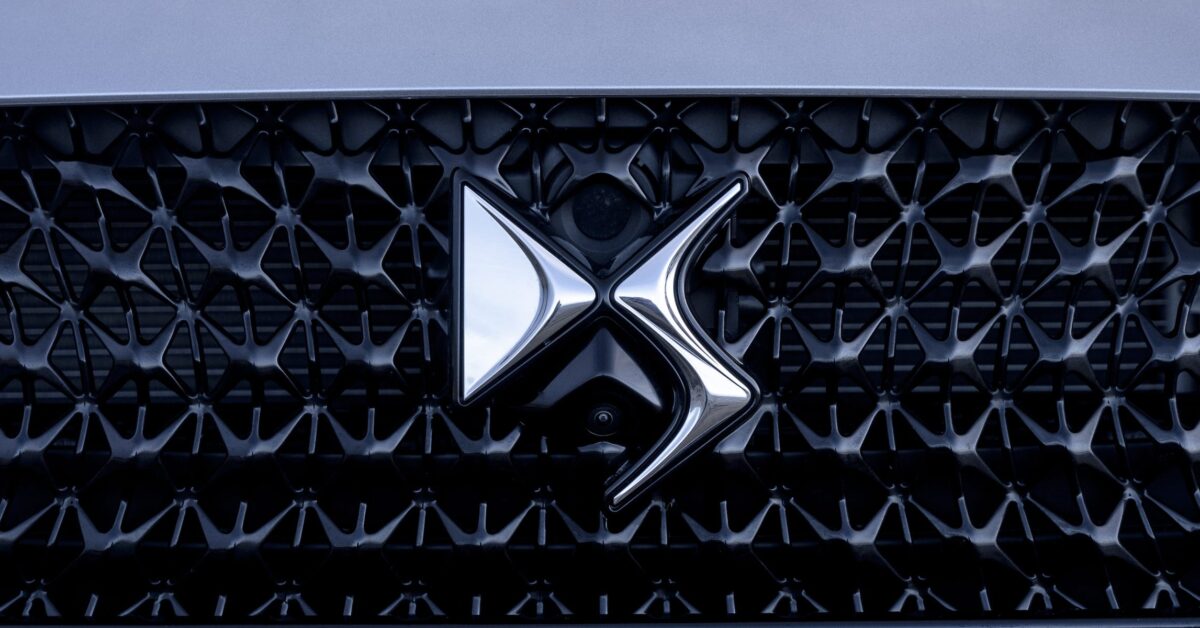
Why is DS called DS? There are several supposed explanations, with the accepted convention being that the name harks back to one of Citroën’s most revered models, the revolutionary Citroën DS that was first launched in the 1950s.
The letters are said to stand for ‘Different Spirit’ or ‘Distinctive Series’, while in French you pronounce DS in a similar way to ‘déese’, and that means ‘goddess’. Take your pick…

Summary
The fashion-dominated image of DS has so far only generated niche appeal here in the UK. The brand is regarded as a bit of an oddity and has never really fully enthused British car buyers. Even the brand’s management have been less than happy with the sales from its UK showrooms.
The planned switch to electric only in 2024 was intended to reinvent the brand, with models launched as recently as 2023, such as the BMW 5 Series-rivalling DS 9, dropped. Global markets have diluted those electric plans but DS management certainly ‘talk the talk’, claiming now they want to go further upmarket to become a rival to the likes of Bentley – brave words, but difficult to see this becoming reality.
You may also like:
This article was originally published in July 2023 and updated in March 2026.