Make and model: Omoda 7 Noble
Description: Mid-size plug-in hybrid SUV
Price range: from £35,000
Summary: The Omoda 7 is the most complete car the brand has brought to the UK yet – a plug-in hybrid SUV that outperforms the pricier Omoda 9 and undercuts equivalent European rivals by thousands of pounds.
Introduction
If you’re still getting your head around who exactly Omoda is, it’s one of three new brands (soon to be four) that Chinese giant Chery Group has launched into the UK over the last couple of years. They all sell various flavours of family SUV, dominated by plug-in hybrids, with a couple of EVs and a couple of petrol models as well.
Omoda is considered the ‘fashion-forward’ brand in the family, but all of them (the others being Chery, Omoda and Lepas) sell SUVs that offer a load of equipment for prices that undercut equivalent European brands by thousands of pounds.
You don’t need to know the company’s background to guess that the Omoda 7 sits between the smaller Omoda 5 and the larger Omoda 9. It’s a mid-sized SUV, launching as a plug-in hybrid model with a purely petrol version to follow later in the year. Two trim levels are available: Knight at £32K and Noble at £35K.
On paper, the plug-in hybrid Omoda 7 Noble sizes up very well to the Omoda 9, which is £10K dearer. The (slightly) bigger car gets more performance and a longer electric-only driving range, but most of the equipment levels are similar.
For a broader ownership picture, see our full Omoda 7 Expert Rating.
Price and equipment
£35,000 for a well-equipped plug-in hybrid SUV with 204hp, a 16-inch touchscreen, heated and ventilated front seats, a panoramic sunroof, a 12-speaker audio system and a seven-year warranty is outstanding value. Rivals with comparable equipment and a plug-in hybrid powertrain routinely cost several thousand pounds more.
The Knight at £32,000 is no poor relation either. It still gets the 16-inch central display, wireless Apple CarPlay and Android Auto, a 50W cooled wireless charging pad, synthetic leather seats, keyless entry and a 540-degree camera system with a transparent chassis view – which shows a real-time image of what’s beneath the car when manoeuvring, and works better than you might expect.
The Noble adds 20-inch alloys, a panoramic sunroof, multi-colour ambient lighting, an upgraded 12-speaker audio, front seat ventilation, a power tailgate and an in-car fragrance system. The seven-year, 100,000-mile new car warranty is standard on both, and it remains one of the strongest ownership commitments available at any price point.


Inside the car
The Omoda 7’s cabin is deliberately different from the Jaecoo 7, which shares the same underpinnings. Where the Jaecoo takes a more upright, vertical approach to its interior design, the Omoda 7 goes horizontal – a wide, low dashboard with a clean, modern feel that works well in practice.
Physical controls are almost entirely absent. The few that exist feel sturdy to the touch, but you find yourself wishing there were more of them. Navigating menus for functions that could be a single button press is a recurring irritation that the car industry as a whole hasn’t solved yet. If you’re going to put everything on a screen, the operating system needs to be rock solid, but Omoda hasn’t quite nailed it – it’s better than plenty of other brands, but not as good as the best in the business.
The central touchscreen is large at almost 16 inches. The right-hand side of the screen is partially obscured by your left hand on the steering wheel, which is an odd oversight on what is otherwise a thoughtful interior. A slightly smaller screen would probably fix it without any real loss. The nine-inch driver’s display suffers from the same issue found in most new cars – too much information, presented in fonts that are slightly too small. Less info, but presented more clearly, would serve drivers better.
The Noble’s fragrance system offers nine scent combinations. My sense of smell is poor, so I can’t offer much personal insight here – others may find it a welcome touch of personalisation, or they may find it unnecessary. Either way, it’s there.
Rear passenger space is generous. Two adults sit comfortably with room to spare, and the floor is flat despite the hybrid powertrain – a genuine achievement that adds to the sense of spaciousness. The boot measures 630 litres, which is notably larger than the Jaecoo 7’s 440 litres and competitive across the segment. Towing capacity is 750kg unbraked and 1,250kg braked.


Driving range and charging
Omoda claims 56 miles of electric-only range from the 18kWh battery. As this was a short launch drive rather than a week-long UK test, real-world range under typical British conditions can’t be confirmed here – expect the usual variation depending on speed, temperature and driving style.
The plug-in powertrain (which Omoda calls SHS, for Super Hybrid System) is interesting. The 1.5-litre petrol engine has been designed specifically for hybrid use rather than adapted from a conventional unit, which means it can be optimised to work more efficiently as it only really drives the wheels at higher speeds. It also means that the engine can charge the battery efficiently and quickly to keep the electric motor full of charge for lower-speed driving.
One practical note worth knowing before you buy: the charging port sits on the right-rear quarter panel, behind the rear wheel. At most UK public charging bays, that means reversing in. It’s not a dealbreaker, but it’s worth factoring into your daily routine.
The SHS can also charge at up to 40kW at public charging points, which is much faster than most plug-in hybrids – typically limited to around 7kW, the same as a home wallbox. And with vehicle-to-load capability standard across the range, the car can supply up to 3kW to external devices, which is a useful real-world addition.
On the road
The Omoda 7 won’t set your pulse racing. The ride is on the heavier side and the car isn’t particularly agile, but then that’s true of most mid-sized family SUVs – the segment prioritises comfort and practicality over driver engagement, and buyers seem broadly fine with that trade-off.
Within those expectations, the Omoda 7 is composed and refined. There’s a bit of roll through corners, which is more noticeable when the car has to change direction along windy roads, but nothing that’s uncomfortable if you’re sticking to the speed limit. The odd bump – even a large one – presents no problem, although repeated bouncing on poor surfaces feels less settled.
With 204hp and plenty of torque on tap, there’s more than enough performance for day-to-day driving. With the electric motor doing most of the work at lower speeds, the Omoda 7 is as responsive as any EV in urban situations. It’s only as the speed builds up through about 40-50mph that the petrol engine really takes charge of driving, which is when the electric motor loses efficiency anyway. So if you’re cruising along a motorway at 70mph, you’re pretty much driving a petrol SUV. The transition from electric to petrol power is quite seamless.
There’s not a lot of noise at speed, either. In fact, the Omoda 7 feels quieter than its big brother, the Omoda 9, although we didn’t take any noise level readings to back this up. The petrol engine is unobtrusive as it switches on and off.


Verdict
The Omoda 7 is the most complete car Omoda has brought to the UK to date, and at £32,000 to £35,000 it represents genuinely strong value in a crowded segment. The plug-in hybrid powertrain is highly efficient, the equipment levels are competitive at both trim levels, and the seven-year warranty remains one of the best ownership commitments available regardless of price.
It won’t excite drivers who prioritise how a car feels through corners, and the near-total absence of physical controls is a reasonable objection. But for a family looking for a well-equipped, practical, efficient SUV that won’t stretch the budget, it’s a serious proposition – and a better car than the Omoda 9 that costs £10K more.
For a broader ownership picture, see our full Omoda 7 Expert Rating.
We like:
- Outstanding value at both trim levels, particularly the Noble at £35,000
- Seven-year warranty that outclasses almost every rival at this price
- Spacious rear cabin with a flat floor despite the hybrid powertrain 630-litre boot, well above average for the segment
- V2L standard across the range, for supplying power to external devices
We don’t like:
- Ride is on the heavy side; not the most engaging car in the segment
- Almost no physical controls, which becomes wearing on longer journeys
- Charging port position means reversing into most public charging bays
- Screen fonts too small; driver’s display tries to show too much at once
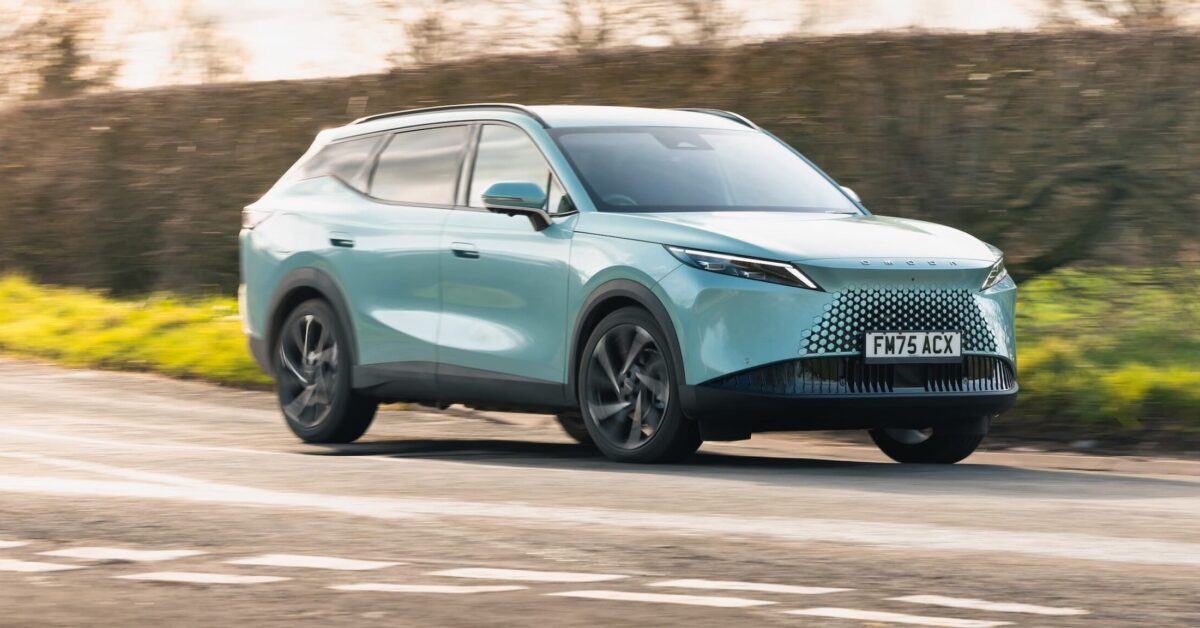
- Dark exterior colours lose much of the design detail – choose carefully
Similar cars
Audi Q3 | Chery Tiggo 7 | Citroën C5 Aircross | Cupra Terramar | Dacia Bigster | Ford Kuga | Honda ZR-V | Hyundai Tucson | Jaecoo 7 | KGM Torres | Kia Sportage | Land Rover Discovery Sport | Mazda CX-5 | MG HS | Mini Countryman | Nissan Qashqai | Peugeot 3008 | Renault Austral | SEAT Ateca | Skoda Karoq | Subaru Forester | Suzuki Across | Toyota C-HR | Vauxhall Grandland | Volkswagen Tiguan
Key specifications
Model tested: Omoda 7 Noble SHS
Price: £35,000
Engine: 1.5-litre petrol engine + electric motor, all-wheel drive
Gearbox: Three-speed hybrid automatic
Power: 204 hp
Torque: 365 Nm
Top speed: 112 mph
0-60 mph: 8.4 seconds
Battery range: 56 miles
CO2 emissions: 23 g/km
Euro NCAP safety rating: Five stars (July 2025)
TCE Expert Rating: Not yet rated (March 2026)