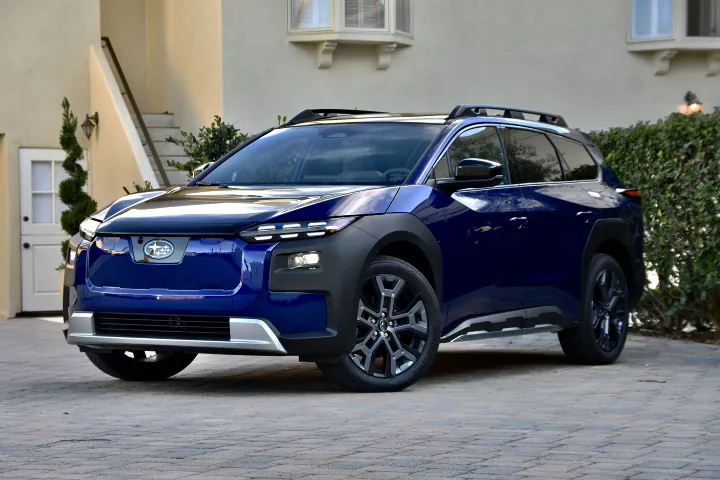

With the 2026 Trailseeker—its third all-electric model—Subaru is finally getting to the point in its electrification journey where it can make something a bit more niche.
Yes, the Trailseeker is marketed as yet another electric crossover starting around $40,000 and aimed at the heart of the market, size-wise. And yes, like Subaru’s other EVs, there’s a Toyota-badged version as well (the bZ Woodland). But the Trailseeker is uniquely Subaru, not only because the automaker did the majority of the development work and will be responsible for all manufacturing (including of the re-badged Toyota), but because its shape screams Outback.

Like Subaru’s defining model, the Trailseeker combines a lifted ride height with a long-and-low, wagon-style roofline. Subaru markets the Trailseeker as an SUV (as it does the Outback), but it deserves to be added to the dwindling list of U.S.-market wagons. The same goes for the bZ Woodland, but Toyota hasn’t been selling a gasoline wagon for decades like Subaru, so it doesn’t have a ready pool of customers who might consider an electric counterpart to their current car.
Returning customers with older Outbacks might also find the Trailseeker more familiar. The 2026 Outback has gotten taller and accumulated more plastic cladding, turning it into a caricature of ruggedness. The Trailseeker is more restrained, making it look more like Outbacks of old, albeit with a blanked-off grille to signifying that it’s electric.
Instead of a boxer-four, the Trailseeker is powered by a pair of electric motors in the typical arrangement of one per axle. They produce a combined 375 horsepower, making the Trailseeker the most powerful Subaru production model sold in the U.S. It’s also the quickest, with a Subaru-estimated zero to 60 mph time of just 4.4 seconds. It’s also quick compared to similarly-priced EVs; a Kia EV6 Light Long Range takes 5.0 seconds to reach 60 mph, according to its manufacturer.

However, the Trailseeker is only 0.3 second quicker in the zero to 60 mph sprint than the smaller 2026 Subaru Uncharted in all-wheel drive form. The 338-hp junior crossover weighs about the same as the Trailseeker, as it turns out. That’s partly because both have a 74.7-kilowatt-hour battery pack, which gives the Trailseeker an estimated 281 miles of range in base Premium trim. The fancier Limited and Touring models are expected to return 273 miles.
Those range estimates are fairly close to all-wheel drive versions of the Uncharted, and competitors only beat them with larger battery packs. The lack of a 300-mile version is unfortunate, but at least Trailseeker customers won’t have to manage the charging of a huge battery pack. The Trailseeker can DC fast charge at just 150 kilowatts using its NACS port (Tesla Supercharger access is included), allowing for a 10 percent to 80 percent charge in 28 minutes, according to Subaru. An overnight Level 2 AC charge should be easily accomplished as well.
Drivers will make good use of that charge port because, in addition to being quick, the Trailseeker is genuinely entertaining to drive. Subaru embraced its World Rally Championship heritage and programmed a little leeway for sideways action into the Trailseeker’s software. The fact that the only Subaru EV you can slide around a corner is also the biggest just makes it that much cooler.

Like the more buttoned-down Uncharted, more thought seems to have gone into the Trailseeker’s steering and suspension tuning than the other mainstream EVs. This electric wagon changes direction quickly, transmits sensations to the driver quite well for a Subaru without a three-letter name, and doesn’t compromise ride quality to do it.
As the name suggests, Subaru also tried to bake in a bit of off-road capability. The Trailseeker has 8.5 inches of ground clearance, Subaru’s X-Mode system with Snow/Dirt and Deep Snow/Mud modes, hill-descent control, and Grip Control, which works like low-speed cruise control when off-road. Like the Outback, it can also be equipped with an off-road camera system, with multiple views that make it easy to spot rocks on your driving line and preserve your rocker panels in tight confines.
The Trailseeker name is nonetheless a bit ambitious. This EV can go farther off road than most owners will ever take it, but it doesn’t feel at home in that environment. Ground clearance is merely adequate, and the lack of suspension travel and articulation, as well as mechanical differentials, mean the Trailseeker mostly relies on electronics to maintain traction. Unlike the bZ Woodland, it also launches without a factory all-terrain tire option. It wouldn’t be surprising to see that on a future Trailseeker Wilderness, though.

Subaru says a full-size dog crate will fit in the back, and while the Trailseeker has less cargo space than an Outback, the 31.3 cubic feet behind the second row and 74.0 cubic feet available with the rear seats folded exceeds competitor EVs. A 3,500-pound towing capacity is pretty good for an EV as well, and the Trailseeker’s lower wagon-style roofline means accessing its standard roof rails will be easier than in a traditional SUV.
Inside, you’ll find similar space to competitor EVs up front, but less rear-seat legroom. The Subaru/Toyota EV aesthetic continues to puzzle. The dashboard and door panels are comprised of pieces that don’t really fit together, and the placement of the instrument cluster necessitates a small, square steering wheel. It all works well enough once your situated, though, and the blue leather upholstery available on Touring models is a nice touch.
Like the overall interior design, the interface was copied and pasted from other Subaru/Toyota EVs. The standard 7.0-inch digital instrument cluster and 14.0-inch touchscreen (running Toyota-based software) look and function pretty much the same as they do in the Uncharted, which is to say adequately, but not remarkably. As in the Uncharted, you can use one of two prominently-placed wireless device chargers after you connect to the standard wireless Apple CarPlay and Android Auto.

Pricing starts at a reasonable $41,445 (including a $1,450 destination charge) for the Trailseeker Premium base model. The Trailseeker Limited adds features like 20-inch wheels, a 360-degree camera system, power liftgate, and Harman Kardon audio system for $45,445 with destination. The top Touring grade’s $48,005 MSRP nets a panoramic glass roof, digital rearview mirror, two-tone paint, leather upholstery, and other features.
This pricing is in line with other mainstream EVs, as well as the rest of Subaru’s electric lineup. You could have a fully-loaded Uncharted or Solterra for about the same price as the mid-level Trailseeker Limited, but the Trailseeker’s extra space and power are worth considering. And the base Trailseeker is about $5,000 less than its Toyota bZ Woodland counterpart, so that’s clearly the one to go with.

While it may not be that much of a deviation from the norm, the Trailseeker’s Outback-like appearance changes things up a little. The range and charging figures show that the Trailseeker could be a better EV, but its design and driving dynamics prove that it’s nonetheless a good car. And shouldn’t that be job one?
[Images © 2026 Stephen Edelstein/TTAC.com]
Become a TTAC insider. Get the latest news, features, TTAC takes, and everything else that gets to the truth about cars first by subscribing to our newsletter.