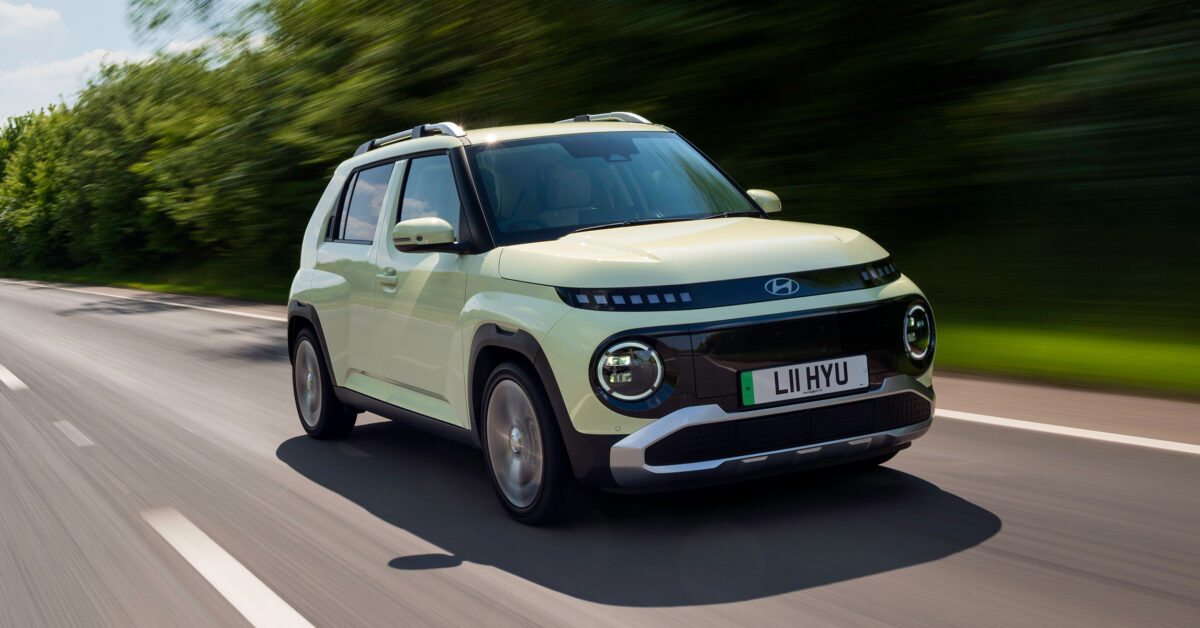
Make and model: Hyundai Inster 01
Description: Small electric hatchback
Price range: From £20,655
Summary: For those wanting to go electric on a budget the Hyundai Inster ticks most boxes, with plenty of equipment, lots of space and a competitive range.
Introduction
The Hyundai Inster launched in the Spring of 2025, becoming the Korean manufacturer’s lowest-priced electric vehicle and pitched firmly as one of the latest breed of more affordable sub £2K EVs – with a grant available as of February 2026 applied, prices currently start at just over £20K.
The Inster arrives in an increasingly competitive market, taking on several rivals including the well-received Renault 5. It’s a proper small car, 3.8 metres long and 1.6 metres wide, but for such compact dimensions, it offers surprising space inside.
In a short period, the Inster has certainly made its mark, particularly for its practicality and stylish looks, which between them defy the affordability tag. Accolades for the Inster include being named The Car Expert’s Best Small Car 2026.
For a broader ownership picture, see our full Hyundai Inster Expert Rating.
Price and equipment
The Inster comes in two equipment levels dubbed 01 and 02, while there is also a separate Inster Cross model with traditional SUV-themed styling, though no extra off-road capability.
The 01 is available with either a 42kWh or 49kWh battery, dubbed ‘Standard Range’ and ‘Long Range’ while the 2 only comes with the larger unit. Prices start at £23,755 for the 01 Standard Range, £25,305 for the Long Range, with the 02 costing from £27,005.
These prices are high compared to rivals, and as of February 2026, the Inster is not eligible for the government’s Electric Car Grant. However, the car’s competitiveness is transformed by Hyundai’s own grant of £3,750 on all versions, bringing the starting price down to £20,655. The grant is currently scheduled to run until March 2026, but we would not be surprised to see it continue.
Generally, the Inster is well equipped – the standard kit includes a heat pump (making the most of the battery’s range, particularly in colder conditions), climate control, keyless entry, Apple CarPlay and Android Auto integration, rear parking sensors, and plenty of ADAS driver aids. The car has a four-star Euro NCAP safety rating, which tends to be normal for smaller cars.
Significant extras one gets by paying close to £2,000 more for the Inster 2 include larger alloy wheels, LED front and rear lights, interior ambient lighting, front parking sensors and a rear-view camera, a heated steering wheel, wireless phone charging and significantly more versatility in the rear, the seats both reclining and sliding.


Inside the car
This may be a small car, but it is surprisingly spacious inside for four occupants (it is very much a four-seater) and their luggage – if you go for the 02. The sliding rear seats can extend the boot space from 238 to 351 litres, but disappointingly, you can only have them in the more expensive model. However, the rear seats do fold completely flat on all versions, while the 02 allows you to drop the front ones too.
The driver’s environment is reassuringly traditional. While the car follows the current norm of a centre touchscreen and another ahead of the steering wheel hosting the essential driver’s information, it also boasts plenty of physical controls.
Hyundai goes completely away from over-reliance on screens, with a whole panel of buttons below the screen, including air-conditioning controls (with manual sliders to change airflow direction), plus essential controls mounted on the steering wheel.
Generally, the interior is well put together, though it’s an environment more of hard plastic than soft-touch surfaces.


Driving range and charging
The Car Expert’s standard range test car is quoted at up to 203 miles between charges, which the long-range extends to 229 miles, or 223 with the Inster 02 due to its extra equipment. These figures stack up well against rivals and while an initial test drive does not allow a real-world mileage calculation, early adopters of the car report satisfactory range results with energy consumption close to the quoted 4.3 miles/kWh.
The Inster will charge at up to 85kW at a public charging point, so a typical 150kW public rapid charger will replenish the battery from 10 to 80% in around half an hour. On a 7kW home wallbox, a full charge will take just over six hours.
The charging port, by the way, is in the car’s front end – just remember to park it the right way round…
On the road
The Inster displays all the typical EV traits of being easy to drive, and its compact dimensions make for a competent performance on urban streets, easily nipping in and out of slower traffic. Unlike many EVs it is front-wheel drive, so it doesn’t have quite such a tight turning circle as some rivals, but with big windows and a high seating position it is very easy to see out of in all directions.
On the open road the car feels planted, little surprise as this is quite a heavyweight in its segment, at around 1.4 tonnes. Our 01 offers a power output equivalent to 97hp while the 02 is rated at 115hp, cutting the 0-62mph time from a pedestrian 11.7 seconds to a still not that impressive 10.6 seconds – slower than rivals such as the Renault 5.
The car accelerates smoothly enough but on the motorway our 01 felt a little underpowered. However 70mph is not this car’s prime environment; it will best suit an owner who does a lot of slower-speed urban driving, and they will be able to make the most of the brake regeneration – the levels of this are easily changed through paddles on the steering wheel.
Ride comfort is generally good, the suspension soft enough to dial out the imperfections of typical urban streets while never feeling wallowy.


Verdict
There is a lot to like about the Hyundai Inster – first-time EV buyers in particular will find it reassuringly easy to drive and appreciate the traditional interior, Hyundai’s designers resisting the temptation to put everything on a touchscreen.
With lots of equipment and space, a generally good performance and competitive range, the Inster is a good-value first EV – so long as you get it with the grant…
For a broader ownership picture, see our full Hyundai Inster Expert Rating.
We like:
- Lots of flexible interior space
- Small car handling good for in-town driving
- Range compares well to rivals
- Plenty of physical controls
- Well-equipped
We don’t like:
- Without grant more expensive than rivals
- Sliding rear seats not standard
- Plenty of interor plastic
- Heavy car for its size
- Underpowered at higher speeds
Similar cars
BYD Dolphin | Citroën ë-C3 | Dacia Spring | Fiat 500e | GWM Ora 03 | Kia EV2 | Leapmotor T03 | Mini Cooper Electric | Peugeot e-208 | Renault 5 | Vauxhall Corsa Electric
Key specifications
Model tested: Hyundai Inster 01 Standard Range
Price: £20,655 (with £3,750 EV grant)
Powertrain: Electric motor, 42kWh battery
Gearbox: Single-speed automatic
Power: 97 hp
Top speed: 87 mph
0-60 mph: 11.7 seconds
Efficiency (combined): 4.2 m/kWh
Battery range: 203 miles
CO2 emissions: 0 g/km
Euro NCAP safety rating: Four stars (July 2025)
TCE Expert Rating: A, 79% (February 2026)
Buy a Hyundai Inster
If you’re looking to buy a new or used Hyundai Inster, The Car Expert’s partners can help you find the right car.