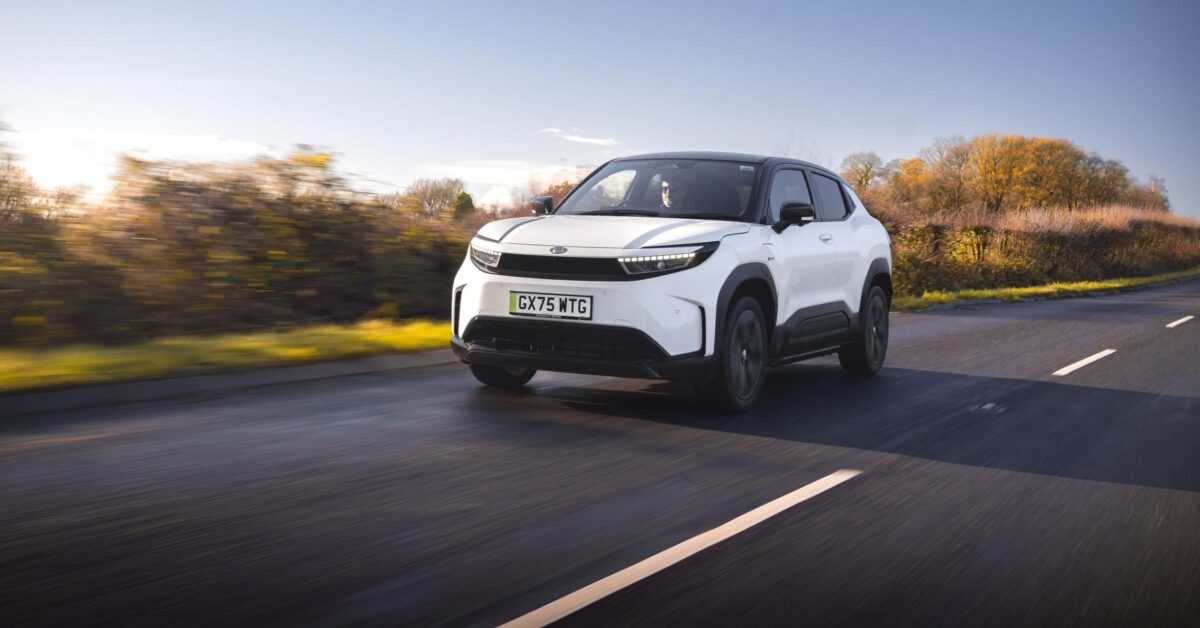
Make and model: Toyota Urban Cruiser
Description: Small SUV/crossover, single electric motor
Price range: £29,995 to £35,745 (plus options)
Summary: The Toyota Urban Cruiser is quiet and well equipped, but slow charging and an unremarkable driving experience leave it behind many similarly priced small EVs.
Introduction
While many brands now offer half a dozen electric models or more, Toyota’s EV range is still small. The Urban Cruiser is only its second fully electric car for the UK.
Rather than being developed entirely in-house, it’s a joint project with Suzuki and built in India. That helps Toyota expand quickly into the small electric SUV market — but it also means this isn’t quite the same as the brand’s newer, more ambitious EV efforts.
We drove the Urban Cruiser at its European launch in Florence, where the roads are smoother and traffic flows more politely than back home. As ever with a launch event, that context matters. A car that feels settled on freshly surfaced Tuscan tarmac may not feel quite so composed on a damp B-road in Surrey.
The question, then, is simple: does the Urban Cruiser feel like a serious contender in a crowded small EV class?
For a broader ownership picture, see our full Toyota Urban Cruiser Expert Rating.
Price and positioning
The Urban Cruiser sits in the heart of the small electric SUV market, alongside cars like the Hyundai Kona Electric, Jeep Avenger and various Stellantis cousins. On paper, pricing is broadly mid-table.
However, there’s a catch. Because the car is built in India, it doesn’t qualify for the UK government’s electric car subsidy. That means some rivals can undercut it by £1,500 or even £3,750 depending on eligibility. Once that’s factored in, the Urban Cruiser starts to look less competitive than its headline price suggests.
There are two motor outputs, although we only drove the more powerful 128kW (174hp) version. A lower-output 106kW model will also be offered in the UK.


Inside the car
Step inside and the Urban Cruiser feels functional rather than fashionable. The cabin is dominated by grey plastics — lots of them — and while nothing appears poorly assembled, it doesn’t feel especially warm or inviting either. It’s more durable than delightful.
The layout follows the now-familiar twin-screen template. Both displays measure ten inches, with the central touchscreen handling most functions. There are a few physical controls for basic air-conditioning adjustments, which is welcome, but much of the interaction still relies on the screen.
Neither display is class-leading. The driver’s screen is clear enough, though slightly plain. The central touchscreen works, but it’s not particularly quick to respond and the menus don’t feel especially slick. Wireless Apple CarPlay and Android Auto are standard, which helps — and many drivers will likely default to that rather than Toyota’s native system.
Seat comfort is broadly average for the class. They’re comfortable enough for everyday driving but don’t offer much in the way of support. On the smooth Italian roads we sampled, that wasn’t a problem, but it’s something we’d want to revisit on a longer UK test.
Boot space is on the small side, and there’s no front storage compartment for charging cables. They’ll have to live under the boot floor, which isn’t ideal if you’re fully loaded for a family trip.


Driving range and charging
The Urban Cruiser’s maximum charging speed is one of its weaker points. The larger-battery version can charge at up to 67kW, while the smaller-battery model tops out at 53kW. In 2026, those figures are modest. Many rivals can charge significantly faster, which matters if you regularly rely on public charging.
The charging port is located just behind the left front wheel, which makes it easy enough to plug in whether you park nose-in or reverse into a bay.
We didn’t conduct a full range test during the launch event, so we’ll reserve judgement on real-world efficiency until a longer UK drive.
On the road
Around town, the Urban Cruiser is pleasant and easy to manage. The 174hp motor provides brisk acceleration from low speeds, and it feels perfectly at home in busy urban traffic. As is typical of electric cars, response is immediate and smooth.
However, that urgency fades at higher speeds. Once you’re out on open roads, acceleration trails off more noticeably than in many rival EVs. It’s not slow, but it doesn’t feel especially energetic either.
The steering is very light and offers little feedback about what the front wheels are doing. That’s not unusual in modern cars, but here it feels particularly detached. Through corners, there’s more body lean than you might expect from an electric vehicle, which usually benefits from a low centre of gravity. The Urban Cruiser feels slightly floaty rather than planted.
Ride comfort is relatively soft, which helps over smoother roads, but because the car is short, it can feel unsettled over uneven surfaces. On the Tuscan launch route, it was just about acceptable. On rougher UK roads, we suspect that movement may be more noticeable.
Braking performance is reassuringly strong, with good pedal feel — something not all EVs manage well. There’s no one-pedal driving mode, which some drivers will miss. Personally, I don’t mind its absence, but it’s worth noting.
Refinement is mixed. Around town it’s impressively quiet, and the lack of engine noise makes it feel calm and civilised. At higher speeds, however, road noise becomes more intrusive than in some competitors.


Verdict
The Toyota Urban Cruiser is likely to be easy to live with. It’s quiet and smooth around town, the controls are simple enough, and there’s nothing here that would make daily driving stressful or complicated. For short journeys and routine family duties, it would slot into life without much fuss.
But this is not Toyota’s strongest work.
The cabin feels built to a budget, charging speeds are well behind much of the competition, and the driving experience lacks the quality and composure you might expect from the badge. It leans more than most electric cars, the steering feels distant, and once you’re out of town the sense of refinement isn’t quite there either.
None of that makes it a bad car. It just makes it a fairly ordinary one in a class that is moving on quickly. And when some rivals are both better to drive and eligible for government incentives that this car misses out on, the Urban Cruiser ends up feeling like a stopgap rather than a standout.
Toyota has shown with the larger bZ4X that it can do electric cars with much more polish. The Urban Cruiser feels more like Toyota covering a space in its line-up than setting a new standard.
For a broader ownership picture, see our full Toyota Urban Cruiser Expert Rating.
We like:
- Quiet and smooth around town
- Simple trim structure with decent standard equipment
- Brakes have good, natural pedal feel
- Sensible charging port location
- Easy and undemanding to drive
We don’t like:
- Slow charging compared to most rivals
- Bland interior with lots of grey plastics
- Light steering with very little feel
- Noticeable body lean for an EV
Similar cars
Alfa Romeo Junior Elettrica | BYD Atto 2 Electric | Citroën ë-C3 Aircross | Dacia Spring | DS 3 E-Tense | Fiat 600e | Ford Puma Gen-E | Honda e:Ny1 | Hyundai Kona Electric | Jeep Avenger Electric | Jaecoo E5 | Kia EV3 | Mazda MX-30 | MG S5 EV | Mini Aceman | Omoda E5 | Peugeot e-2008 | Renault 4 E-Tech | Skoda Elroq | Smart #1 | Suzuki e-Vitara | Vauxhall Frontera Electric | Vauxhall Mokka Electric
Key specifications
Model tested: Toyota Urban Cruiser Design
Price: £33,495
Engine: Single electric motor, front-wheel drive
Gearbox: Single-speed automatic
Power: 128 kW (174 hp)
Top speed: 93 mph
0-60 mph: 8.7 seconds
Efficiency (combined): 4.2 m/kWh
Battery range: 164 miles
CO2 emissions: 0 g/km
Euro NCAP safety rating: Not yet tested (as of February 2026)
TCE Expert Rating: Not yet rated (as of February 2026)