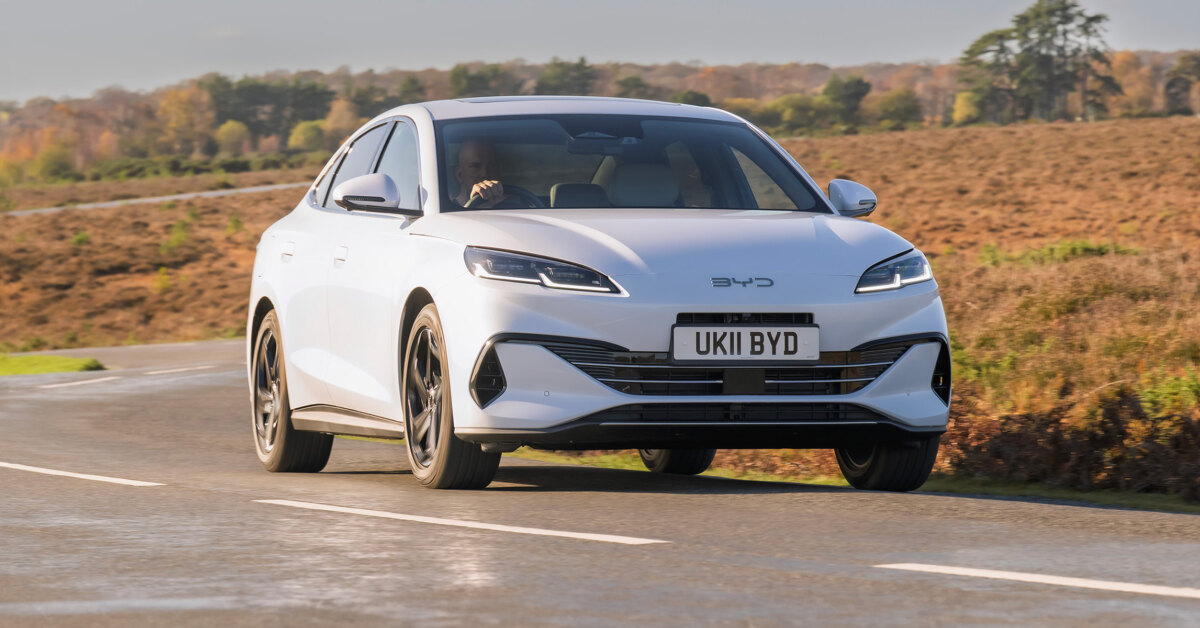
Make and model: BYD Seal 6 DM-i
Description: Mid-size range-extender saloon and estate
Price range: From £33,990 (saloon), £34,990 (estate)
BYD says: “The Seal 6 DM-i is a perfect choice for both business and private customers seeking an EV driving experience with the real-world flexibility of a Super Hybrid…”
We say: Enthusiastic drivers won’t like the BYD Seal 6, but those looking for a practical EV for not so much outlay could well be attracted to it.
Introduction
BYD has, without doubt, made the biggest impact of the clutch of Chinese brands launching into the UK. Not much more than two years after arrival, it’s rapidly growing a significant slice of the UK market, shifting more than 51,000 cars in 2025.
This has been achieved partly through heavy marketing – withlots of highly visible sponsorship of sporting events, for example – but mainly due to an aggressive launch programme. The Seal 6, which arrived on our roads in December 2025, is the eighth BYD model launched so far in the UK. And with the BYD UK dealer network already numbering more than 100 outlets, it will be easy to check out.
This is the third Seal model, the 6 number distinguishing it from the Seal ‘super saloon’ launched in 2023 and with which the newcomer shares no significant mechanics, and the more recent Seal U plug-in hybrid SUV, which employs the same chassis at the 6. Available in saloon and estate forms and priced to significantly undercut the competition, the new model is likely to keep BYD’s progress on track.
What is it?
On top of that Seal U plug-in hybrid chassis is a choice of saloon or estate body styles (the latter dubbed Touring). The estate is likely to be the higher seller of the two body styles by quite a margin, as British buyers are notoriously shy of buying saloons – except in the premium market, a status which BYD may aspire to but which it has not reached yet.
Who is this car aimed at?
These two new offerings from BYD are typical of the kind of cars that the likes of Audi, BMW and Mercedes-Benz have been doing for years – executive saloons with estate options for those who need more practicality than a car with a boot offers.
The car’s makers will no doubt be hoping to attract some of those who have previously bought in the premium sector, to boost both overall sales and the general image of BYD. More likely, however, the car will prove attractive to more mainstream buyers, especially in estate form where it will stack up well against other electric contenders.
One major attraction will be the price, which undercuts comparable upmarket rivals by at least £10,000 more. That alone will persuade many buyers to look at the Seal 6, while it’s also significantly cheaper than rivals from the likes of Skoda and Volkswagen while offering comparable quality of build and practicality.
BYD’s big challenge will be to get potential buyers to try the car in the first place, but judging by the brand’s sales figures so far, it’s managing this rather well.
Who won’t like it?
Likely to be less impressed by the BYD are those who regard Chinese-built cars with a degree of suspicion, but more pertinently, those who really enjoy driving their cars. While few of the currently mushrooming choice of electric vehicles offer much driving pleasure and feel through the steering, the BYD Seal 6 is particularly innocuous in this respect.
The car also suffers from the over-zealous driver warnings that seem to be particularly intrusive on cars coming out of China – while European law requires that these warnings are fitted, traditional European manufacturers seem to be doing a better job of dialling down the irritation factor.
First impressions
The Seal 6 is a big car, both versions measuring up at more than 4.8 metres long and having wheelbases of close to 2.8 metres, claimed to be longer than any of their rivals.
In terms of looks, some have dismissed the 6 as bland, but this reviewer thinks the designers have done a better job than many, with none of those awkward flat panels that some EVs replace grilles with. BYD claims class-leading aerodynamic figures for its new model and even the Touring estate version looks suitably swoopy.
Having said that, in a rapidly growing world of electric cars the Seal 6 offers little to nothing in its exterior design to mark it out from the crowd.
We like: Easy on the eye exterior design, spacious
We don’t like: Nothing that distinctive to make the car instantly recognisable


What do you get for your money?
Two trim levels are available for the Seal 6, dubbed Boost and Comfort, with saloon versions costing from £34K and the Touring £35K. Opt for the higher trim Comfort specification and you add £3K to the price, which many might want to do as it adds significant powertrain upgrades as well as equipment additions.
Highlights of the entry-level specification include 17-inch alloy wheels, metallic paint, a 13-inch central touchscreen with a separate nine-inch digital display for the driver, rear parking sensors and camera and a vehicle-to-load function, allowing external electrical equipment to be powered by the car.
Comfort variants come with a larger battery, which means a virtually doubled range on electric power only, and faster onboard AC charging.
The alloy wheels expand by an inch, other niceties including a heated steering wheel, heating and ventilation on the front seats, ambient lighting, wireless phone charging, a panoramic sunroof and a more upmarket audio system. The central touchscreen gets bigger too, to 16 inches, though one can choose to specify a ‘Comfort Lite’ model which retains the smaller screen.
The list of accident-avoidance driver aids is as long as one expects these days, and it’s little surprise that the Seal 6 clocked up a top-level 5-star rating in its Euro NCAP crash tests, scoring highly in all categories.
Overall, the Comfort model appears the one to go for, the extras on offer fully justifying the £3,000 price hike, particularly if you’re financing the car through a PCP or lease, since the monthly payment step is likely to be minimal.
Like all BYD models, the Seal 6 comes with a six-year warranty, with eight years on all the electric powertrain bits.
We like: Highly competitive pricing
We don’t like: Electric range compromise on Boost models
What’s the BYD Seal 6 like inside?
The large impression of the BYD Seal 6 translates to a feeling of roominess inside, particularly in the rear cabin which is seriously spacious for a mid-sized car, even above the head with the panoramic sunroof fitted to Comfort trim versions.
Fit and finish is to a reasonably high standard too, the textured vegan leather upholstery complemented by some quality surface treatment and a complete lack of scratchy plastic. It’s not to the best executive car stands but it compares well with mainstream rivals.
Saloon buyers get a boot of 491 litres, which when one folds down the 60:40 folding rear seats jumps to 1,370 litres. This is not bad, particularly when you consider the car does not have the underfloor stowage of its sister. The boot opening is significantly narrower than that of the Touring, however.
The Touring naturally accommodates rather more, though the space available doesn’t come close to matching some admittedly much more expensive European rivals.
You get 500 litres if loaded to the level of the parcel shelf, 675 when packed to the roof and 1,535 with the rear seats dropped. Fold those seats, using a handy lever in the bootspace, and the floor is completely flat, unlike in the saloon, while all Tourings also come with a powered tailgate and aluminium roof rails as standard.
As with virtually all of today’s new vehicles the driver’s environment is dominated by a central touchscreen, of 13 or 16 inches depending on the trim level selected. Unlike previous BYD offerings, this one doesn’t swivel from landscape to portrait mode, being fixed in its ‘floating’ form ahead of the fascia. It’s reasonably user-friendly but physical buttons for some of the more frequently-used functions would be preferable.
We like: Rear seat space particularly impressive.
We don’t like: Saloon is less practical than Touring


What’s under the bonnet?
The BYD Seal 6 employs the same basically plug-in hybrid technology that arrived with the Seal U SUV in 2024. Technically, it’s a range-extender – the two electric motors do all the work of putting power to the road, while there is a 1.5-litre engine purely as a support, both generating power when needed to replenish the battery and supplying energy directly to the motor when required.
BYD calls its drivetrain ‘Super Hybrid with DM Technology’, the DM standing for dual mode as the powertrain can operate in ‘Series Hybrid’ or ‘Parallel Hybrid’ form, selecting said mode automatically and also able to be selected manually via a button on the steering wheel – should for example one want to use the car in electric-only mode.
How it all works is not particularly important to the average driver, who instead will appreciate that the presence of the engine means that there will never be any fear of running out of range, even if you forget to plug the car in overnight.
On paper the electric range figures don’t rate higher than other more traditional plug-in hybrids but the BYD technology ensures that the electric part plays a role throughout the journey and not simply at the start before becoming a heavy weight draining fuel economy.
The car will spend most of its time in use running like a full EV and the Comfort versions, which use a larger 19kWh battery, can travel more than 60 miles on electric power alone – the Boost with its 10kWh unit only manages 34 miles.
With a full battery and full tank of fuel both models claim remarkable official total ranges in excess of 900 miles, with the Boost managing around 30 miles further than its more specification-heavy sibling. You won’t get such figures in real-world use but you will go a long way without needing to fill up.
Both versions are suitably swift too – sprinting from zero to 62mph is accomplished in under nine seconds and they can go on to 111mph.
In terms of recharging, Boost models have only a 3kW onboard AC charger, Comfort versions 7kW, which means a full at-home recharge will take three hours for a Boost, and about 20 minutes less on the Comfort. All versions can go from 30 to 80% in 23 minutes using a suitable DC charger.
What’s the BYD Seal 6 like to drive?
Getting going in the BYD Seal 6 is designed to be easy – with the app installed on one’s smartphone a simple tap on the mirror unlocks the car and brings it to life. And general progress is equally as simple as modern EVs provide – points where the petrol engine wakes up smooth enough to be virtually unnoticeable.
The Seal 6 does, however, feel a little too floaty – while the ride comfort is generally agreeable, and cruising for example on a motorway very comfortable, poor surfaces will rather too easily unsettle the car and running over any potholes or depressions will certainly be felt by the cabin occupants as the suspension struggles to catch up.
Over-light steering is an EV trait and the Seal 6 maintains the trend. However it does stay pleasingly planted and upright even when cornered at speed.
In the driver’s seat more physical buttons apart from the touchscreen would be nice – while BYD bigs up the ease of use of said screen, simple tasks such as reducing the cabin temperature take too much looking at said screen and not at the road ahead.
And as ever, the driver alerts continue to be a source of irritation and this car’s particularly so, notably the instruction to keep one’s eyes on the road, and turning it off is not the matter of a moment. Manufacturers really need to understand that drivers do need to look sideways on a regular basis, particularly at junctions…
We like: Very easy to start and drive
We don’t like: Ride quality easily unsettled on poor roads


Verdict
The BYD Seal 6 is another competent package from this still new to the UK brand, which is yet to completely drop the ball on any of its releases. The saloon will attract a niche audience, the Touring a rather wider clientele and while some will be turned off by sometimes iffy ride quality, what this car offers for the money and the general quality of its build could attract plenty of customers.
Similar cars
BMW 330e | Mercedes-Benz C-Class PHEV | Skoda Octavia iV | Toyota Corolla Touring Sports | Volkswagen Passat eHybrid
Key specifications
Model tested: BYD Seal 6 DM-I Boost Saloon / Comfort Touring
Price as tested: From £33,990
Powertrain: Hybrid – two electric motors, 1.5-litre engine
Gearbox: Automatic
Power: 135 / 156 kW (184 / 212 hp)
Torque: 300 Nm
Top speed: 111 mph
0-62mph: 8.9 / 8.5 seconds
Range: 935 / 839 miles (WLTP)
CO2 emissions: 52 / 38 g/km
Euro NCAP safety rating: Five stars (November 2025)
TCE Expert rating: Not yet rated (December 2025)
Buy a BYD Seal
If you’re looking to buy a new or used BYD Seal, The Car Expert’s partners can help you find the right car.