A very mixed year for new car sales came to an unsurprisingly mixed end in December, according to data published today by the Society of Motor Manufacturers and Traders (SMMT).
Private new car sales were strong, with the best results in three years after poor showings in 2023 and 2024. However, this was partially offset by another slowdown in fleet registrations. Overall, the market was up 4% on the same month last year, with private sales up 16% but fleet registrations down 2%.

December’s results were slightly better than the full-year result, which saw an overall market growth of 3.5%. This comprised a 4.5% increase for private sales and a 2.5% increase for fleets. It means that total registrations broke the two million mark for the first time since 2019, back before Brexit kicked in and the Covid pandemic struck. It’s still well down on the peak numbers from a decade ago, fuelled by lots of 0% finance on three-year PCP deals, but it is another small step forward from the depths of the Covid years.
Chinese takeaway is a sweet and sour result
However, within the modest overall growth, the market has seen enormous change. While most of the focus and noise has revolved around EV sales and government mandates, the biggest single story of 2025 has been the long-expected arrival of the Chinese car industry in full force.
After years of preparations and some small-scale launches, 2025 was the year when Chinese car brands arrived in force, with a significant impact on the market and representing a real threat to any number of established ‘legacy’ car brands.
BYD, for example, registered about 8,800 cars in 2024. Last year, that jumped to more than 51,000. Chery Group (Chery, Jaecoo, Omoda) saw even more dramatic growth, from 3,600 cars in 2024 to more than 53,000 in 2025. Meanwhile, MG (a very old British brand but now building all its cars in China) continued more than a decade of growth, putting more than 85,000 new cars on the road last year.
These are the ‘Big Three’ of the Chinese brands in the UK, and all have big plans for considerably more growth next year. But there will also more from 2025’s other new arrivals – Leapmotor (part of the Stellantis family), Geely (which also owns Volvo, Polestar and Lotus), Changan and Xpeng. And then there are more brands that will arrive in 2026, like Aion, Zeekr and Denza (which is BYD’s premium brand, a bit like Lexus is to Toyota).
While the overall new car market grew by about 67,000 cars last year, those Chinese brands grew by about 110,000 cars – meaning that the ‘legacy’ non-Chinese brands actually lost more than 40,000 sales compared to the year before. The prospects for 2026 is more of the same, with Chinese brands muscling struggling European and Japanese brands out of the way.
The good news for consumers – at least in the short term) is that this has led to significant price cutting and discounting, both on EVs and fossil-fuel cars.
EVs hit their mandate target – despite what you may have heard
The UK government’s ZEV (zero emissions vehicle) mandate calls for an ever-increasing number of new cars to be electric each year. The target for 2025 was 28% of all new cars, whereas the final number ended up at about 23%. This has led to certain parties with vested interests to regard the result as a failure, but it actually wasn’t.

The mandate has allowances and loopholes to allow car companies other ways to hit their targets, like reducing overall CO2 emissions, buying credits from other companies, and more. Once all of these flexibilities are taken into account, the real target was approximately 20-22% (depending on who you ask, as each car manufacturer had its own targets to meet to make the final numbers work). So, the result of 23% was safely above the net mandate target.
More than 56% of all new car registrations in December were ‘electrified’ (regular hybrids + plug-in hybrids + electric cars), which is a record. This will keep on growing each year as we continue to transition from purely fossil-fuel cars to purely electric cars. This change is accelerating, not just thanks to EVs but also due to a resurgence in plug-in hybrids. Again, this is likely to continue into 2026.
Good month, bad month
We’ll look at the full-year results in a dedicated feature, but each month sees brands overachieve and underachieve, and this is how they all fared in December. The overall market was up by 3.5% compared to the same month in 2024, but there was plenty of good and bad news inside that overall result.
It was a good end to the year for Alfa Romeo, Alpine, Audi, BYD, Ford, GWM, Jaecoo, Maserati, MG, Omoda, Polestar, Skywell, Smart and Suzuki. All of these brands outperformed the overall market by at least 10% (so grew by at least 13.5%).
Meanwhile, Christmas wasn’t quite as enjoyable for Abarth, Bentley, Citroën, Dacia, DS Automobiles, Fiat, Genesis, Honda, Ineos, Jeep, Lexus, Maxus, Mazda, Mercedes-Benz, Mini, Nissan, Peugeot, Porsche, SEAT, Skoda, Subaru, Tesla, Toyota and Vauxhall. All of these underperformed against the overall market, meaning their registrations were down by at least 6.5%.
That meant that the following brands were about where you’d expect them to be in December: BMW, Cupra, Hyundai, KGM, Kia, Land Rover, Renault, Volkswagen and Volvo. All of these brands were within +/-10% of the overall market.
In terms of volume, BYD had the largest growth with an extra 6,300 cars put on the road compared to last December – a 467% increase. Going in the other direction, Tesla was a surprise for the month’s biggest loser, dropping almost 2,400 cars compared to the previous December. The company has recorded huge sales in December for the last five years, so this was quite a turnaround. Whether this was a one-off performance or a sign of things to come for 2026 remains to be seen, but it’s certainly been a controversial year for Elon Musk’s company.
As usual, Volkswagen was the UK’s best-selling brand in December (and for the whole year), ahead of MG, Ford, BMW and Audi.
Ford Puma retains its sales crown
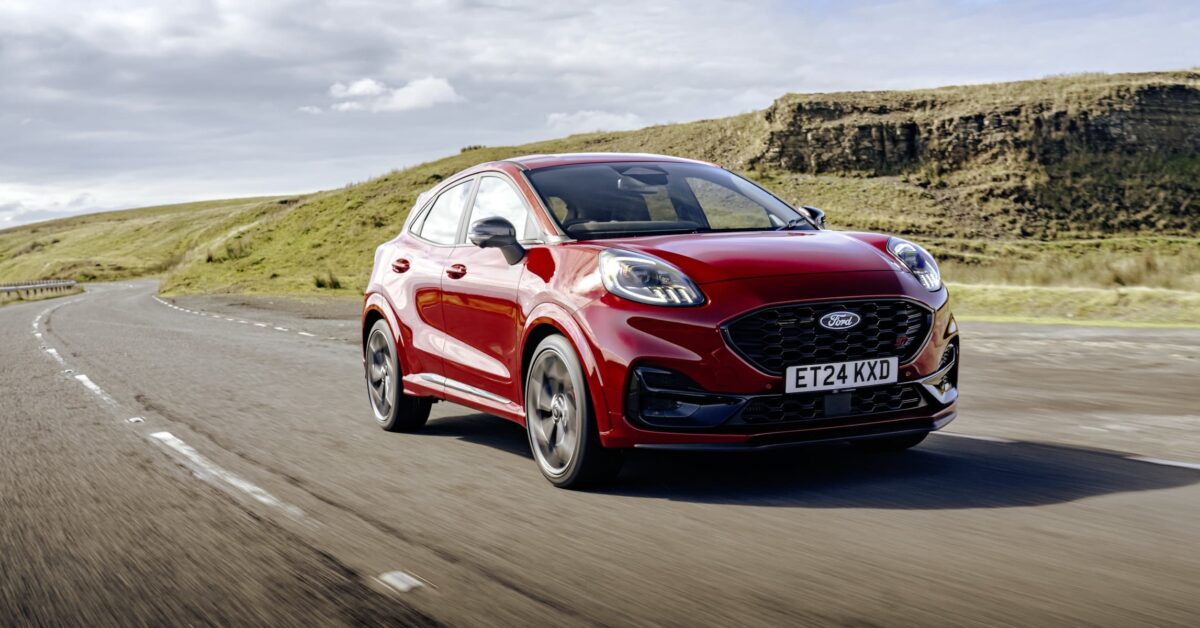
For the second year in a row, the Ford Puma was the UK’s best-selling new car. Once again, it defeated the Kia Sportage, which once again went curiously AWOL in December. The result was more decisive than in the previous year, with the Puma outselling the Sportage by more than 7,500 units (compared to just 1,200 last year).

The biggest surprise of the month was a relatively subdued result for Tesla, which had dominated the December sales charts for the previous five years. The Model Y did finish second in December, while the Model 3 was down in ninth. Last year, they were first and second, as they were in 2022.
MG had a strong month, with the ZS small SUV placing fourth and the HS mid-sized SUV in seventh. We’ll have a usual full analysis of the top ten cars for 2025 shortly.