Make and model: Toyota bZ4X, 2025 update
Description: Medium electric SUV
Price range: from £39,995
Toyota says: “The new bZ4X benefits from significant technical upgrades, increased customer choice, new equipment features, refreshed design and enhanced dynamic performance and ride comfort.”
We say: The mid-life update to the Toyota bZ4X has addressed many of the flaws that niggled the original version, while enhancing Toyota’s reputation for practicality and user-friendliness.
Introduction
Time does fly. It’s been three years since Toyota launched its first EV, the bZ4X. It landed pretty much in the middle of a rapidly growing market of mid-sized electric SUVs, offering some good qualities but not class-leading in any way. And over the last three years, there have been at least a dozen new models that have mostly surpassed the bZ4X in key ownership criteria. Toyota needed to respond, and this is the result.
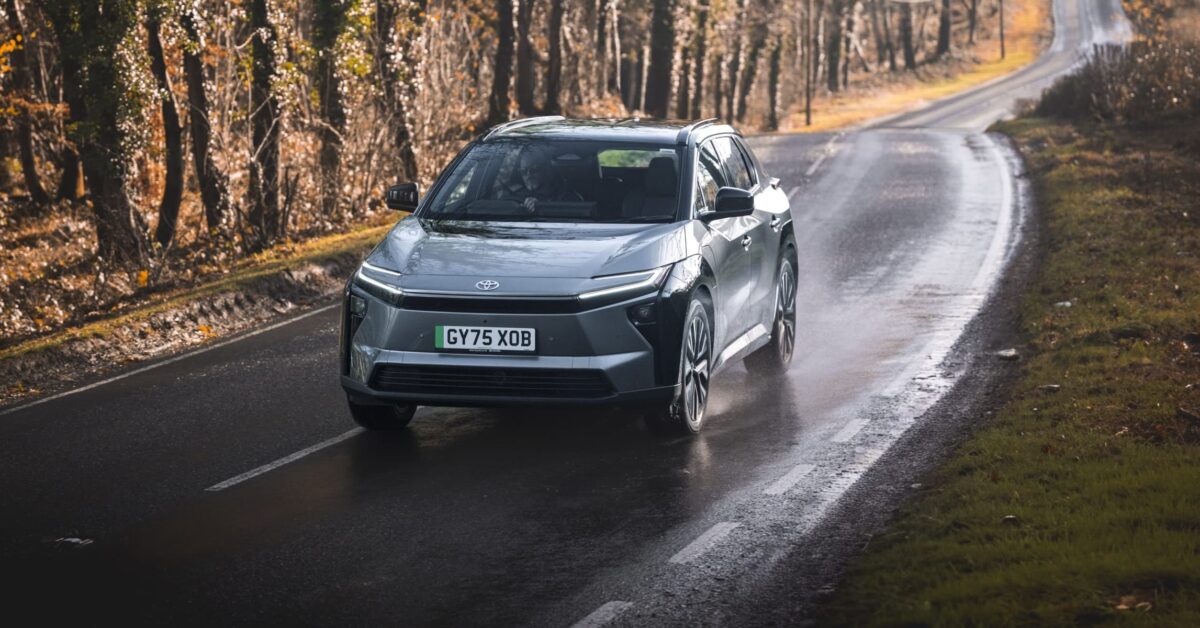
Visually, there’s been a modest makeover – although it’s still far from the prettiest new car on the market. The most notable change is at the front, with a redesign to bring the bZ4X in line with the company’s latest design themes. Inside, there’s also been a bit of a makeover but, again, it’s nothing radically different. The biggest changes are under the skin, and we’ll explore them in detail.
What is it?
The Toyota bZ4X is a mid-to-large electric SUV, similar in size to the likes of the Nissan Ariya and Skoda Enyaq. It’s Toyota’s first EV, with the world’s largest car brand being well behind the curve in launching dedicated electric models. The company is finally starting to catch up, with a couple more models set to join the bZ4X in 2026 and more expansion set to follow each year.
The bZ4X was developed in conjunction with Subaru, so the Subaru Solterra is basically the same car with some minor visual differences. It also forms the basis for the more upmarket Lexus RZ.
The most significant part of the 2025 updates is a much better driving range, thanks to battery and electric motor developments. Other changes are the usual mid-life visual and specification tweaks, and some useful improvements that may be minor but are still welcome.


First impressions
The Toyota bZ4X was notably angular and somewhat visually challenging when it was first launched, and the update hasn’t really changed things too much. Externally, the nose and headlights have been restyled to match other new models in the Toyota family, while the cladding panels around the wheels are now gloss black rather than a dark matt grey.
It all looks purposeful rather than pretty, which is an impression that continues inside. Toyota has reworked the dashboard and centre console quite a bit, though you’d need before-and-after photos to appreciate the difference. Functionally, it all works sensibly and practically, but it generally looks and feels like you’re sitting in a large household appliance rather than a motor car.
We like: Interior improvements are small but worthwhile
We don’t like: Why does it have to be so ugly?
What do you get for your money?
As part of the 2025 update, Toyota has reworked its trim levels to align them with the rest of its range. So out go ‘Pure’, ‘Motion’ and ‘Vision’, and in come the more familiar (for Toyota customers) ‘Icon’, ‘Design’ and ‘Excel’.
Other than trim, the big news with the update is in the powertrain. This was the weakest point of the original bZ4X, so it was a crucial element for Toyota to improve, and this has been achieved. There are now two battery sizes, three motor options and a choice of front-wheel drive or all-wheel drive – although the varaious configurations are spread across the three trim levels.
While the original version was only available with one battery size (71kWh), the updated model now offers an entry-level version with a smaller 58kWh battery. This is only available in the base Icon specification. The Design and Excel models now offer a slightly larger 73kWh battery – although driving range has improved by more than you’d expect, which we’ll explore below. While all versions are offered in front-wheel drive, only the top Excel model is available with all-wheel drive.
The upshot is that the official government-lab-test driving range for the most popular versions (Design and Excel in front-wheel drive) has improved from 317 miles to a far more useful 352 miles, which should also be more achievable in real-world driving thanks to other mechanical improvements. The entry-level model has an official driving range of 275 miles, while the top-spec all-wheel drive model loses range compared to the front-wheel drive version, dropping to 291 miles.
Pricing officially starts at £40K for the entry-level Icon with the smaller battery, but realistically most customers are going to skip over that and head to either the Design or Excel models, which come with the bigger battery and are priced at £45.6K and £49K, respectively. If you really need the extra performance of the all-wheel drive version, you’re looking at £51.5K.
Bear in mind that, as with any new EV at the moment, there will be plenty of deals around that will bring these prices down. As of December 2025, Toyota is offering up to £4,000 as a deposit contribution and 0% APR on consumer PCP car finance deals, but check with your dealer as terms and conditions will obviously apply. The deals will also change over time, so always check for the best deals available before signing up to anything.
In terms of what you’re getting for your money, all trims are decently equipped and competitive with what you get from other brands. However, the smaller battery and less powerful motor make the entry-level Icon look like a price-leader – in other words, it attracts attention by being priced at £39,995, but you’re probably much better off with the Design model that’s £5,600 dearer. It’s also worth pointing out that the smaller battery will probably hurt resale value if you want to sell the car in a few years.
The bZ4X comes with a three-year / 60,000-mile warranty as standard, which is pretty much the bare minimum offered by any manufacturer in the UK. However, the warranty period can be extended up to a maximum of ten years / 100,000 miles if you service the car with an official Toyota dealer each year. The battery is under warranty for eight years / 100,000 miles.
We like: Improved battery range and efficiency
We don’t like: Entry-level Icon model will probably be less attractive at resale time
What’s the Toyota bZ4X like inside?
Toyota has made quite a few improvements to the bZ4X cabin, but you’re not going to really spot them unless you’ve jumped from an older model. The biggest changes are down the middle of the front of the cabin – the central touchscreen is larger than before, while the centre console has been redesigned and now sits a bit lower than before, which makes things a bit roomier and more comfortable. The overall look is certainly cleaner, although the materials still tend to be dominated by hard, grey plastic – a Toyota trademark, although not one to be particularly proud of.
The driver’s display is set back on the dashboard and above the top of the steering wheel, so it’s a cross between a head-up display and a traditional instrument binnacle – much like most new Peugeots, although the implementation seems to work better. This makes it very easy to glance down and see your speed, as well as other info like remaining range. The steering wheel has loads of buttons in two groups, one either side of the central horn. In practice, they work well and are certainly better than the haptic swipe controls you see on some other brands.
Climate controls are a mix of physical dials and large touchscreen buttons, which are better than many other new cars to operate on the move. All models get wireless Apple CarPlay and Android Auto, along with two charging pads on the centre console. Unfortunately, these are just hard, flat plastic pads and your phone will fly across the cabin if you swerve or brake hard. Softer, gripper charging pads would be more useful.
There’s a decent amount of storage space inside with door bins, space under the central armrest and so on. The boot is on the smaller side than many other cars in this class, although there’s room for charging cables beneath the floor so these don’t clutter load space (as long as you don’t need to empty the boot to get the cables out…). A frunk would be nice to store your cables away from your luggage, but you don’t get one.
In the back, bZ4X has a flat floor and plenty of legroom for tall rear passengers. The seat backs can be set to a more upright or reclined position depending on preference, or they fold down to extend the rear loading space. After a couple of hours of driving, the front seats still felt comfortable and supportive, which is good.
We like: Spacious interior for front and rear passengers
We don’t like: No frunk or glovebox


What’s under the bonnet?
The upgraded Toyota bZ4X is available with three different powertrain configurations:
- 167hp (123kW) motor, front-wheel drive, 58kWh battery, up to 275 miles of range (Icon trim)
- 224hp (165kW) motor, front-wheel drive, 73kWh battery, up to 352 miles of range (Design or Excel trim)
- 343hp (252kW) motor, front-wheel drive, 73kWh battery, up to 291 miles of range (Excel trim)
As well as more performance, the all-wheel drive model can tow twice as much weight as the front-wheel drive models (1,500kg braked trailer vs. 750kg). But if you don’t need the extra performance, traction or towing capacity, then the sweet spot of the range is the mid-level powertrain configuration. This provides plenty of real-world performance and driving range for most households, and a choice of two trim levels.
The biggest shortcoming of the bZ4X range previously was poor battery range, which often fell well short of the claimed maximum 317 miles. This has been the main focus of the mid-life upgrade, and the results appear to show a number of significant improvements.
As well as a slightly larger battery than before, the configuration of the battery is also more efficient. That means better driving range and quicker charging times across all weather conditions. You can also pre-condition the battery to reduce charging times, either scheduling it before charging is due to begin at home overnight, or when you have programmed a fast-charging point as a navigation destination (assuming you’re using the car’s nav system, rather than Apple or Google maps).
The electric motors have also been developed for better performance and greater efficiency. Toyota has improved the maximum power output of the motors by about 11%, as well as reducing energy losses in the system to improve range. The all-wheel drive model has been further enhanced for performance and handling, as well as off-road performance.
What’s the Toyota bZ4X like to drive?
We drove both the mid-spec front-wheel drive model and the top-spec all-wheel drive model at the European launch in Spain. Apart from the steering wheel being on the other side, these were both the same sort of specs that we are getting in the UK.
For normal family driving, the mid-spec model (224hp, front-wheel drive) has plenty of performance and also offers the best range. Being an EV, you get instant response for the cut and thrust of normal driving, and you’re only going to notice it starting to run out of puff if you’re loaded up with passengers trying to overtake uphill at motorway speeds. For the other 99% of the time, it’s more than enough.
If you do want or need more performance, the all-wheel drive model bumps things up to 343hp, making it one of the most powerful models Toyota has ever offered in the UK. About two-thirds of the drive still comes from the front, with a smaller second motor at the back providing up to about a third of the maximum power. It’s mainly useful for helping to spread the load around in slippery conditions, like wet or icy roads, or when you’re off-road and may be struggling for traction on a loose surface.
Toyota has used special ‘acoustic glass’ in the front side windows to help reduce wind noise, along with foam insulation at key points in the body frame to help reduce road noise. There are also additional silencers and sound-absorbing materials in the panel lining, reducing noise from the (now quieter) electric motors. All of this adds up to a very quiet and refined cabin, even by normal EV standards. You get very little noise from your own car, while also being beautifully insulated from wind, road and traffic noise coming from outside.
The new Toyota bZ4X has also received some suspension tuning to improve both comfort and handling. The company claims that rear-seat passengers will particularly notice a more comfortable ride, but we didn’t get to ride out back to confirm this. Overall, it’s certainly a comfortable thing to drive on mostly very good Spanish roads, while handling through a windy mountain section was predictable and stable.
As with most new cars, you may as well enjoy the comfort as there’s very little actual driving enjoyment to be had. The battery is mounted low in the car, under your feet, so the centre of gravity is very low. That helps to minimise any kind of body roll and can make it feel like you’re going quite slowly when you’ve actually barrelled into a corner a bit too quickly. The brakes are reassuringly powerful and there’s no drama if you need to hit them hard in a hurry. In other words, it’s an excellent family car.
We tried a relatively mild off-road route in the all-wheel drive model, which was hardly trekking through a jungle but which did bounce the car around quite a lot. The bZ4X stayed composed and went exactly where it was told with no complaints or wild moments, so it should suit anyone with typical rural environments in the UK.
The bZ4X comes with Toyota’s latest suite of preventative safety systems, which generally work well and don’t drive you crazy – unlike more than a few rivals. As with all new cars, some of these can’t be permanently disabled so you have to deactivate them at the start of each trip. Blame the EU for this latest nanny-state tech, which now plagues every new car. The fact that every car manufacturer is now offering shortcuts to disable these systems as easily as possible shows how poorly thought-out this stuff is.
We like: Very quiet, refined and smooth at all speeds
We don’t like: Not much fun to be had for the driver


Verdict
Toyota’s first attempt with the bZ4X was good in most areas but crucially off the pace in key areas like battery range. The original shortcomings have been addressed quite thoroughly and commendably; rather than just slinging in a bigger, heavier battery and calling it a day, Toyota engineers have clearly taken time to evolve almost every aspect of the car’s powertrain to get better performance while sipping on less electricity than before. These improvements alone are enough to elevate the bZ4X’s status from an also-ran to a genuine contender.
The interior improvements follow a similar path. Toyota has worked to make the cabin experience better in many ways, rather than just popping in a bigger screen and some new seat trims. Changing most of the dashboard and centre console would have been an expensive decision, but it makes the car much better.
This is now the car that the Toyota bZ4X should have been three years ago. It’s still not the prettiest car in its class – although it’s certainly more distinctive than most – but everything follows the usual Toyota pattern of excellent functionality with somewhat clunky styling. If you’ve been driving something like a RAV4 or a Camry and are now looking for an EV, you’ll feel right at home and probably very happy with the new bZ4X – and it’s now a car we’re very happy to recommend.
Similar cars
If you’re looking at the Toyota bZ4X, you might also be interested in these new and used alternatives
BYD Sealion 7 | Changan Deepal S07 | Citroën ë-C5 Aircross | Ford Mustang Mach-E | Hyundai Ioniq 5 | Hyundai Kona Electric | Kia EV5 | Leapmotor C10 | MG S6 EV | Mini Countryman Electric | Nissan Ariya | Peugeot E-5008 | Renault Scenic E-Tech | Skoda Enyaq | Subaru Solterra | Tesla Model Y | Vauxhall Grandland Electric | Volkswagen ID.4 | Xpeng G6
Key specifications
Model tested: Toyota bZ4X Design
Price (as tested): £45,795
Engine: Single electric motor, front-wheel drive
Range: 352 miles
Power: 224 hp (165 kW)
Torque: 269 Nm
Top speed: 99 mph
0-60 mph: 7.4 seconds